Every structural support system tells the same story. The cable trays get specified. The strut channel gets ordered. The conduit gets installed. And then someone realises they have not accounted for the brackets and fixings that hold the entire thing together.
It is one of the most common oversights in UK construction and M&E projects — and one of the most expensive to fix after the fact.
Brackets and fixings are the connective tissue of any structural support system. They join channel sections, secure frameworks to walls and floors, create right-angle connections, handle angled geometry, and anchor entire support structures to the building fabric. Get them right and your installation is solid, safe, and built to last. Get them wrong and you are looking at remediation work, failed inspections, and in the worst cases, structural failure.
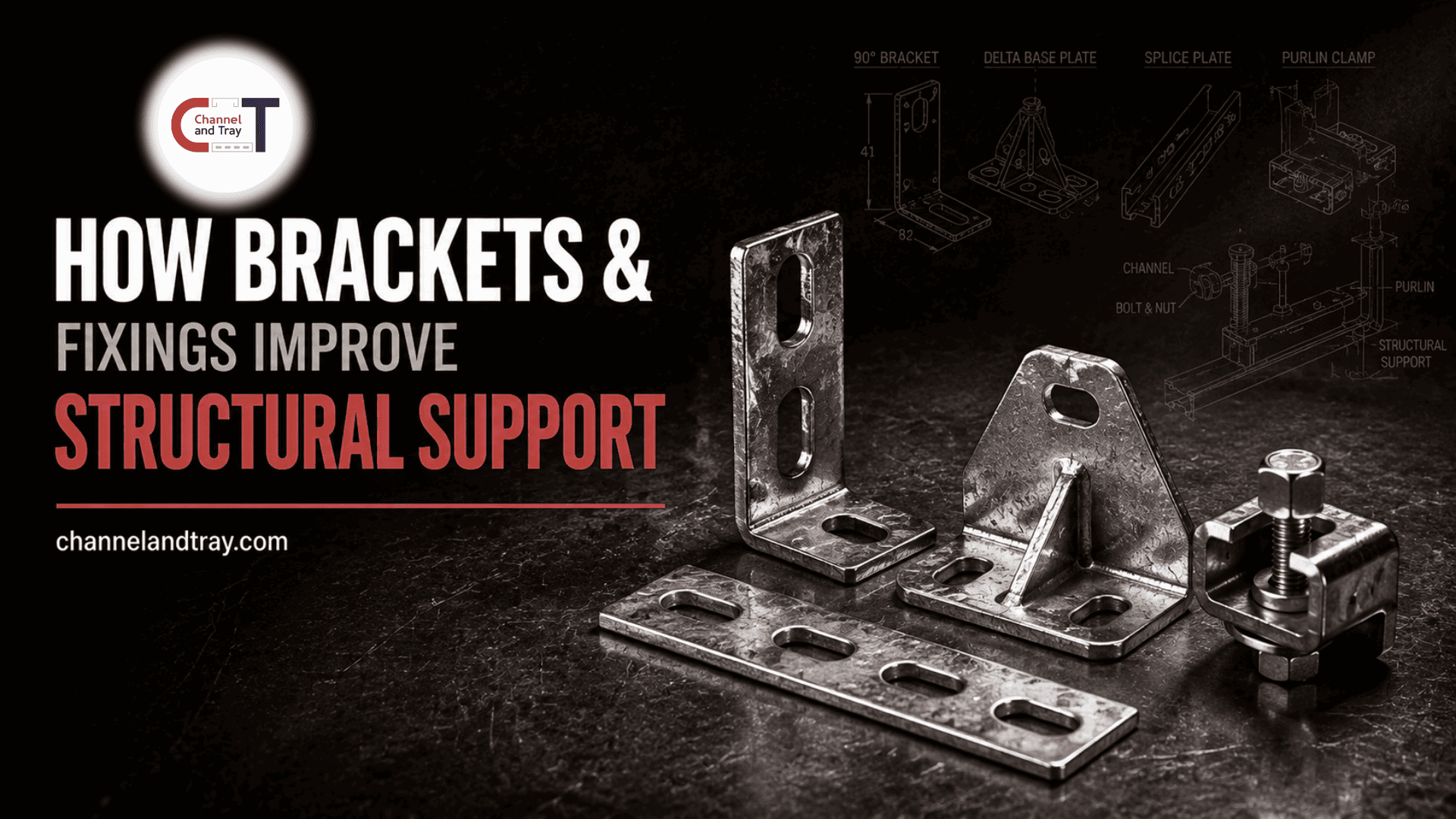
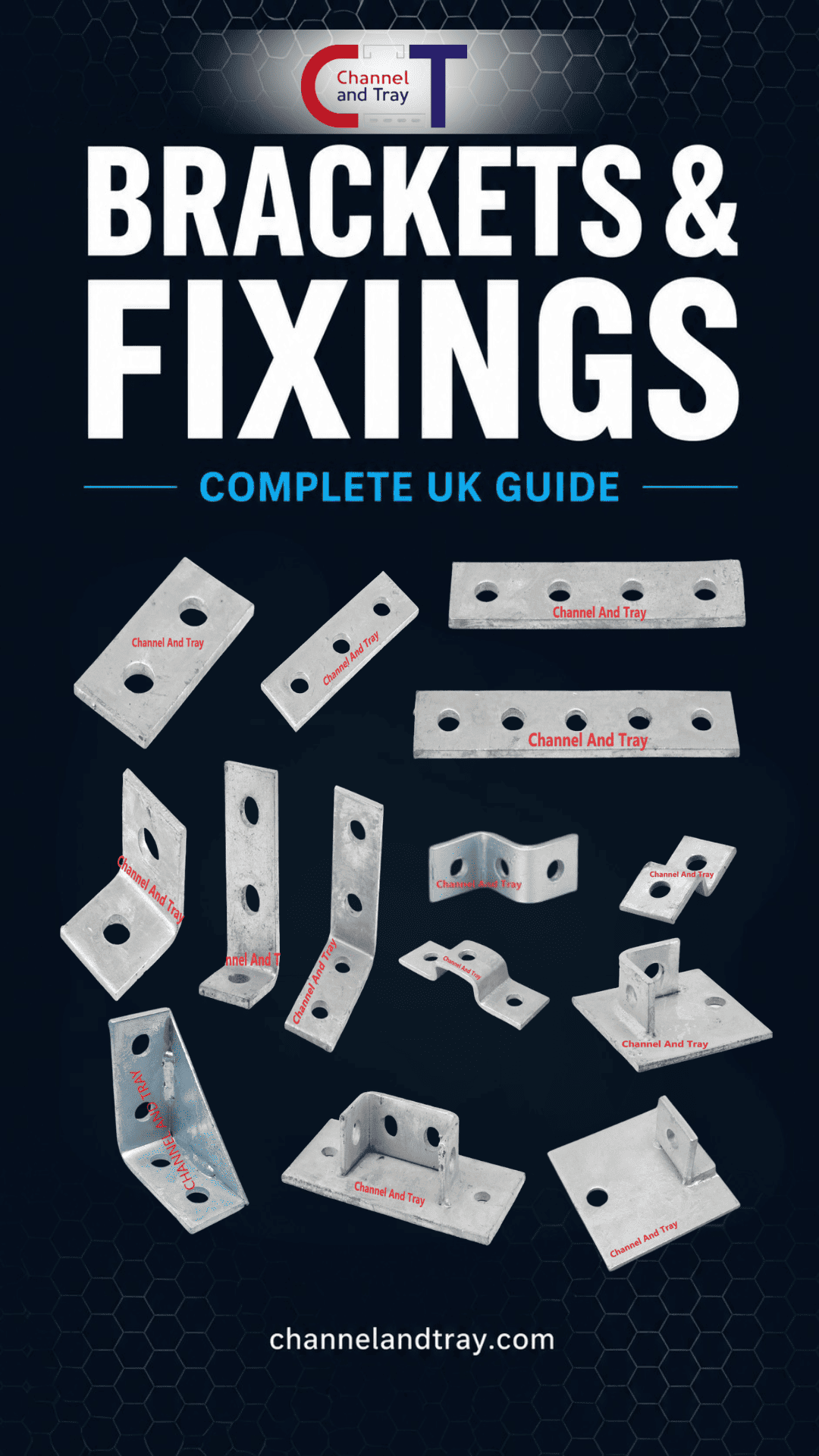
At channel and tray, we supply a comprehensive range of brackets and fixings for UK construction, mechanical, electrical, and industrial projects — from simple splice plates and 90-degree brackets through to delta base plates, purlin clamps, and specialist angle brackets. Everything you need to build a professional, compliant support system, all sourced from one trusted UK supplier.
This guide covers the full range, explains what each product does, and answers the questions that UK contractors and engineers ask most often.
What Are Brackets and Fixings & Why Do They Matter?
At their most basic, brackets and fixings are the hardware components that connect, secure, and stabilise structural support systems. In the context of strut channel and cable management installations — which is where they are most widely used in UK M&E and construction projects — they perform several critical functions.
They join channel sections end to end, maintaining structural continuity across long runs. Create right-angle and angled connections where channel frameworks change direction or branch off. They anchor channel systems to floors, walls, ceilings, and structural steelwork. And they provide the stability that allows the entire support system to carry its intended load safely and reliably over its service life.
Why does specification matter so much?
Because not all brackets are interchangeable. A 2-hole splice plate that is perfectly adequate for a light-duty internal channel run is not the right choice for a heavily loaded industrial framework. A standard 90-degree bracket that works well on a straightforward right-angle connection is not going to perform correctly if forced into an application that needs an acute or obtuse angle bracket.
The consequences of underspecifying brackets and fixings range from minor — loose connections that require retightening — to serious: structural failure, cable tray collapse, and the kind of incident that results in injury, insurance claims, and significant remediation costs.
Across UK construction, M&E, and industrial installations, channel brackets and associated fixings are used to support cable trays, conduit systems, pipework, HVAC ductwork, lighting gantries, and general structural frameworks. Specifying correctly from the outset is not optional — it is fundamental to a safe and compliant installation.
Flat & Splice Plates — Joining and Extending Channel Systems
Splice plates are used wherever two sections of strut channel need to be joined end to end. They sit flat across the join, bolting through the channel to create a continuous, load-bearing connection. The number of holes determines the length of the plate, the number of fixing points, and therefore the strength of the connection.
2 Hole Flat / Splice Plate
The 2 Hole Flat / Splice Plate is the most compact splice plate in the range. With one fixing point on each side of the join, it provides a basic connection suitable for light-duty applications where loads are low and spans are short.
Typical uses include joining channel sections in internal commercial installations, light cable management frameworks, and anywhere a simple, low-profile join is sufficient. It is not the right choice for heavily loaded or long-span applications — for those, step up the hole count.
3 Hole Flat / Splice Plate
The 3 Hole Flat / Splice Plate offers a longer plate with an additional central fixing point, increasing the rigidity of the join and providing better load distribution across the connection.
This is a versatile mid-range option suitable for the majority of standard channel joins in commercial and light industrial installations. The extra fixing point makes a noticeable difference to joint stiffness — particularly over longer spans where deflection under load is a consideration.
4 Hole Flat / Splice Plate
Step up to the 4 Hole Flat / Splice Plate when the installation demands greater connection strength. Four fixing points spread the load more effectively across the join, making this plate suitable for medium to heavy-duty applications.
You will find 4-hole splice plates used in industrial channel frameworks, heavily loaded cable tray support systems, and any application where the join needs to perform reliably under sustained mechanical stress.
5 Hole Flat / Splice Plate
The 5 Hole Flat / Splice Plate is the most robust splice plate in the range. Five fixing points, the longest plate length, and maximum load distribution make this the correct specification for the most demanding applications — long-span frameworks, heavily loaded industrial support systems, and anywhere structural integrity at the join point is absolutely critical.
When in doubt about which splice plate to specify, it is always better to step up rather than down. The cost difference between a 2-hole and a 5-hole plate is negligible compared to the cost of a failed joint.
90 Degree Brackets — Right-Angle Connections Done Right
Right-angle connections are among the most common structural requirements in any channel framework — and having the correct 90-degree bracket for the specific application makes a significant difference to both the strength and the neatness of the finished installation.
90 Degree Bracket
The standard 90 Degree Bracket is the workhorse of any channel support system. It creates a clean, rigid right-angle connection between two channel sections — whether that is a wall bracket supporting a horizontal run, a corner connection in a three-dimensional framework, or a connection between vertical and horizontal channel members.
Robust, versatile, and compatible with standard strut channel, the 90-degree bracket is one of the most frequently ordered components in any channel installation. If you are building a support framework and you have not accounted for your right-angle brackets, you will notice the gap quickly.
2 Hole 90 Degree Bracket
The 2 Hole 90 Degree Bracket is a more compact right-angle bracket with two fixing holes — one on each face. It is suited to lighter applications where space is limited and the loads involved do not require a larger, multi-hole bracket.
Common applications include light cable management supports, smaller channel frameworks in commercial interiors, and anywhere a compact right-angle connection is needed without the bulk of a full-size bracket.
2 Hole x 2 Hole 90 Degree Bracket
Where additional rigidity is required at a right-angle connection, the 2 Hole x 2 Hole 90 Degree Bracket provides two fixing points on each face — four in total. This two-point fixing on both faces significantly increases the resistance to rotation and racking at the joint, making it the correct choice for connections that will be subject to vibration, dynamic loading, or higher static loads.
In industrial installations, plant rooms, and anywhere the support framework needs to resist movement as well as static load, the 2 Hole x 2 Hole bracket is the more reliable specification.
90 Degree Flat Plate
The 90 Degree Flat Plate takes a different approach to right-angle connections. Rather than a formed bracket, it is a flat plate bent to 90 degrees — used for surface-to-surface connections where a low-profile fixing is needed or where the geometry of the installation does not suit a standard bracket profile.
Flat plates are particularly useful in tight spaces, on flat structural surfaces, and anywhere a slim, unobtrusive right-angle connection is the practical solution.
Tee Plates and Base Plates — Building Stable Frameworks
If splice plates join channel end to end and brackets create right-angle connections, tee plates and base plates are what anchor the entire framework to the building structure. These are the components that determine how stable and how permanent your support system is.
4 Hole Flat Tee Plate
The 4 Hole Flat Tee Plate is used at T-junction points in a channel framework — wherever a channel run branches off perpendicularly from a main run. With four fixing holes arranged in a T configuration, it provides a secure, load-distributing connection at three-way junctions.
T-junctions are common in large cable tray support frameworks, distribution systems where multiple runs branch off from a central spine, and complex industrial frameworks where channel runs cross and branch in multiple directions.
Single Fix Base Plate
The Single Fix Base Plate is used to mount a single channel section to a floor, wall, or structural surface. It provides a stable, secure base fixing point — the foundation from which vertical or angled channel runs can extend upward or outward.
Single fix base plates are used extensively in floor-mount support structures, wall-mount channel frameworks, and anywhere a single channel needs to be anchor firmly to a structural surface.
Double Channel Base Plate
Where two parallel channel sections need to be mounted side by side from a common base, the Double Channel Base Plate provides a single, stable fixing point for both. This keeps twin-channel frameworks aligned, stable, and properly spaced — far more reliably than trying to fix two individual base plates at the correct spacing.
Double channel base plates are common in heavier support frameworks where twin-channel construction is use to increase load capacity, and in installations where parallel channel runs need to be maintain at a consistent centre distance.
Delta Base Plate
The Delta Base Plate is the most stable base fixing in the range. Its triangulated delta shape distributes the load across a wider footprint and provides significantly greater resistance to tipping, racking, and lateral movement than a standard flat base plate.
Delta base plates are specified for heavy-load applications, tall vertical channel runs where the risk of tipping is greater, and any installation. Where the support structure needs to remain absolutely stable under demanding conditions. If your base fixing is going to be under serious load or in a high-vibration environment. The delta base plate is the correct specification.
Angle Brackets — When 90 Degrees Is Not the Answer
Not every structural connection in a real-world UK installation is a clean right angle. Buildings have angled rooflines, pitched ceilings, diagonal structural members, and geometry that simply does not conform to 90-degree assumptions. That is where angle brackets earn their place.
Acute 45 Degree Angle Bracket
The Acute 45 Degree Angle Bracket is used wherever a connection needs to be made at an angle less than 90 degrees. In structural support terms, this typically means connecting channel to a sloping or angled surface, or creating a diagonal brace within a framework.
Common UK applications include supporting channel runs along pitched roof structures, creating diagonal bracing in tall vertical frameworks, and connecting channel to angled structural steel members where the geometry dictates an acute angle connection.
Trying to force a standard 90-degree bracket into an acute angle application is a false economy — the result is a connection under constant bending stress that will loosen over time. The acute angle bracket is designe for the geometry and performs correctly within it.
Obtuse 45 Degree Angle Bracket
The Obtuse 45 Degree Angle Bracket handles the opposite situation — connections at angles greater than 90 degrees. This bracket is use wherever the structural geometry opens out beyond a right angle, such as on wide-pitche roof structures, angle wall connections, and installations where channel needs to follow the slope of a surface that opens away from vertical.
Together, the acute and obtuse angle brackets give you the flexibility to handle the full range of angular connections that arise in real-world UK construction and industrial projects — without resorting to improvised fixings that compromise structural integrity.
External Coupler 21mm Channel & Purlin Clamp — Specialist Fixings Explained
External Coupler 21mm Channel
The External Coupler 21mm Channel is a specialist joining component designed specifically for 21mm strut channel. Unlike internal couplers that fit inside the channel, the external coupler wraps around the outside of the channel at the join point — providing a secure, aligned connection without reducing the internal channel space.
This is particularly useful in installations where the internal channel slot needs to remain unobstruct for fittings, or where the channel run is already fill with components and an internal coupler cannot be insert. The external coupler gives you a reliable, neat join option that works from the outside.
Purlin Clamp
A purlin is a horizontal structural member in a roof or wall framework — typically a steel section running perpendicular to the main rafters or columns in a steel-framed building. Purlins are the structural element that the roof cladding or wall panels attach to, and in industrial, agricultural, and commercial steel-framed buildings across the UK, they are the primary structural anchor point for overhead support systems.
The Purlin Clamp is a specialist fixing designe to attach strut channel and support frameworks directly to steel purlins without the need for drilling or welding. The clamp grips the purlin flange securely, providing a reliable fixing point from which cable trays, conduit, pipework, and lighting can be suspend or support.
Purlin clamps are widely use in warehouses, factories, agricultural buildings, sports halls, and any steel-frame structure where overhead support systems need to be attach to the building’s structural steelwork quickly, securely, and without compromising the structural steel itself.
Why Choose Channel and Tray in the UK?
Sourcing brackets and fixings in the UK should be straightforward. At channel and tray it is.
Here is what you get when you order your brackets and fixings from Channel and Tray:
- Complete product range — Every splice plate hole count, every bracket configuration, every base plate type, and every specialist fixing including purlin clamps and external couplers. No need to source components from multiple suppliers — everything is available in one place.
- Competitive UK pricing — channelandtray.com is committed to offering some of the most affordable prices on brackets and fixings in the UK. Professional-grade products at prices that work for trade buyers and large procurement orders alike.
- Fast UK delivery — Stock held ready for despatch. Whether you need a handful of 90-degree brackets for a job starting tomorrow or a full suite of fixings for a major project, orders are processe and ship quickly to keep your programme on track.
- Quality assured — All brackets and fixings meet relevant UK and European standards. Every component is specified for professional installation use — not budget hardware that will fail under load.
- Easy online ordering — The full range is clearly organised and easy to navigate at channelandtray.com. Find the product you need, check the specification, add to basket, and order — without delays or unnecessary complexity.
Whether you are a sole trader needing a few base plates for a straightforward job or a procurement manager sourcing fixings for a major construction project, channel and tray has the range, the stock, and the pricing to support you.
The quality of any structural support system comes down to the quality of its connections. Splice plates that distribute load properly across channel joins. Right-angle brackets that hold their geometry under sustained stress. Base plates that keep frameworks anchored and stable. Angle brackets that handle real-world geometry without compromise. Purlin clamps that attach to structural steelwork securely and cleanly.
None of these are afterthoughts. Every bracket, every plate, every clamp in your installation is doing a structural job — and specifying the right one for the application is what separates a professional installation from one that will cause problems.
Browse the complete range of brackets and fixings at channel and tray — and get the right components for your next UK project, with competitive pricing and fast delivery as standard.
Common Questions People Ask
- What is the difference between a splice plate and a flat plate?
A splice plate is specifically designe to join two channel sections end to end — it sits across the join and is bolte through both channel sections to create a continuous connection. A flat plate is a general-purpose plate use for surface-to-surface connections, right-angle connections, or T-junctions depending on its configuration. The two serve different structural purposes.
- How do I know which bracket to use for my application?
Start with the geometry — is your connection at 90 degrees, an acute angle, or an obtuse angle? Then consider the load — how much weight will the bracket need to carry, and over what span? Light-duty internal applications can use smaller, fewer-hole brackets. Heavy-duty or industrial applications should use larger brackets with more fixing points. When in doubt, step up rather than down — the cost difference is small, the structural difference is significant.
- Can brackets and fixings be use outdoors in the UK?
Yes, provided the correct finish is specified. Galvanised brackets and fixings offer good corrosion resistance for outdoor and exposed environments. For particularly aggressive environments — coastal locations, chemical exposure, or permanently wet conditions — stainless steel or hot-dip galvanized options should be considere. Always check the product specification against your environment before ordering.
- What is a purlin clamp use for?
A Purlin Clamp is used to attach strut channel and support systems to steel purlins in steel-framed buildings — without drilling or welding. It is an essential fixing in warehouses, factories, agricultural buildings. Steel-frame structure where overhead support systems need to be anchore to the building’s structural steelwork.
- How many holes do I need on a splice plate?
The number of holes determines the length of the plate and the number of fixing points — and therefore the strength of the connection. For light-duty internal applications, a 2-hole plate may be sufficient. Medium-duty applications, a 3 or 4-hole plate is more appropriate. For heavy-duty or long-span applications, specify a 5-hole plate. If you are unsure, err on the side of more fixing points.
- What is a delta base plate use for?
A Delta Base Plate is used to mount channel to a floor or structural surface where maximum stability is required. Its triangulated shape distributes load across a wider footprint and resists tipping and lateral movement far more effectively than a standard flat base plate. It is the correct specification for heavy-load vertical channel runs, high-vibration environments, and any application where base stability is critical.