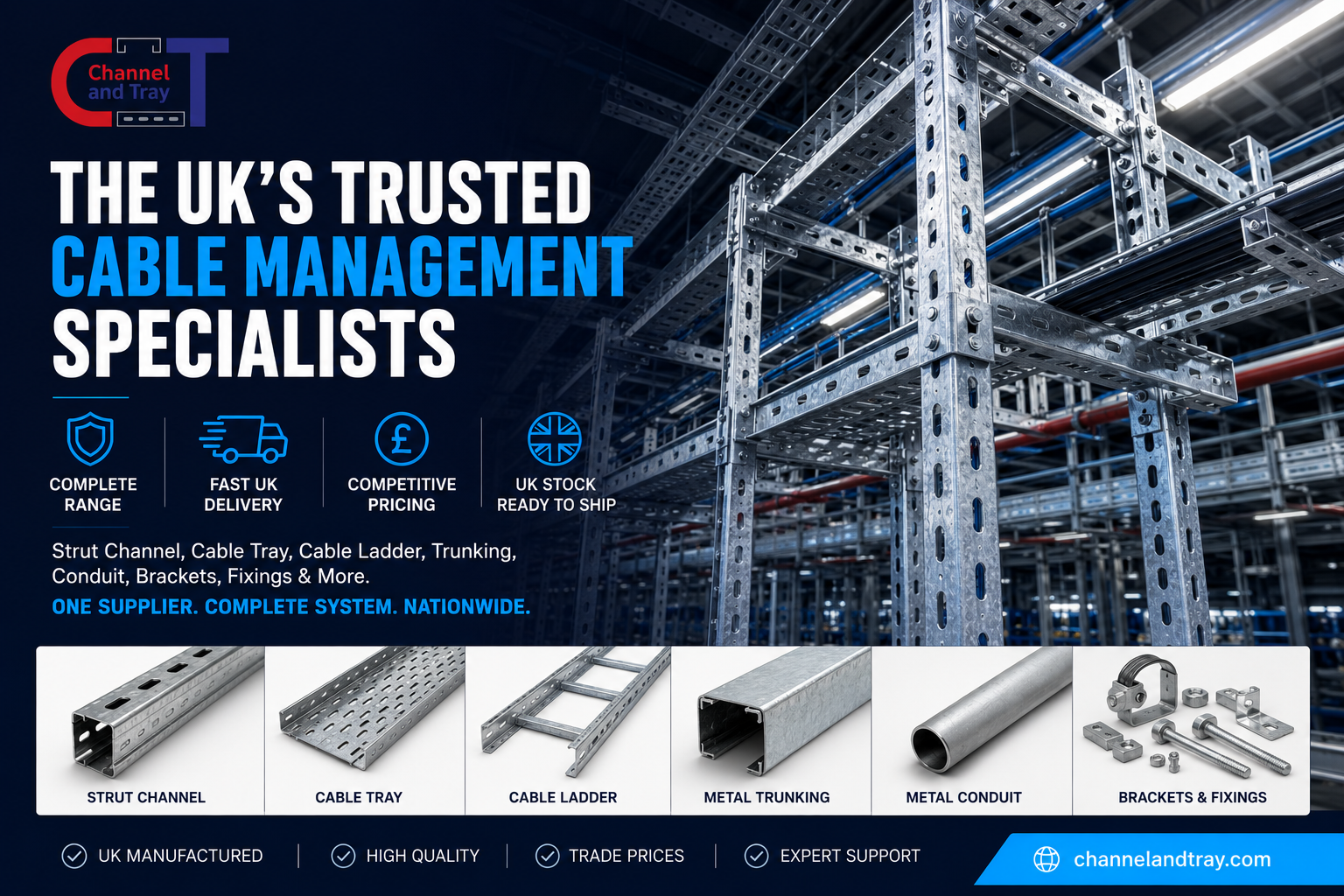
Whether you are wiring a new commercial office in Manchester, fitting out an industrial facility in Birmingham, or upgrading electrical infrastructure on a construction site in London, cable management is one of the most critical — and most overlooked — aspects of any electrical installation.
Poorly managed cables create real risks: fire hazards, tripping dangers, signal interference, and costly maintenance problems down the line. Getting it right from the start means choosing the correct cable management system for the job.
At Channel and Tray, we supply a comprehensive range of cable trays, trunking, strut channel, and all the fittings you need to complete a professional, compliant installation anywhere in the United Kingdom. This guide covers everything you need to know about cable trays and trunking — from product types and applications to common questions answered plainly.
What Are Cable Trays & Trunking?
Cable trays and trunking are two of the most widely used cable management systems in the UK electrical industry. While they serve a similar purpose — organising, protecting, and routing cables — they differ in design and application.
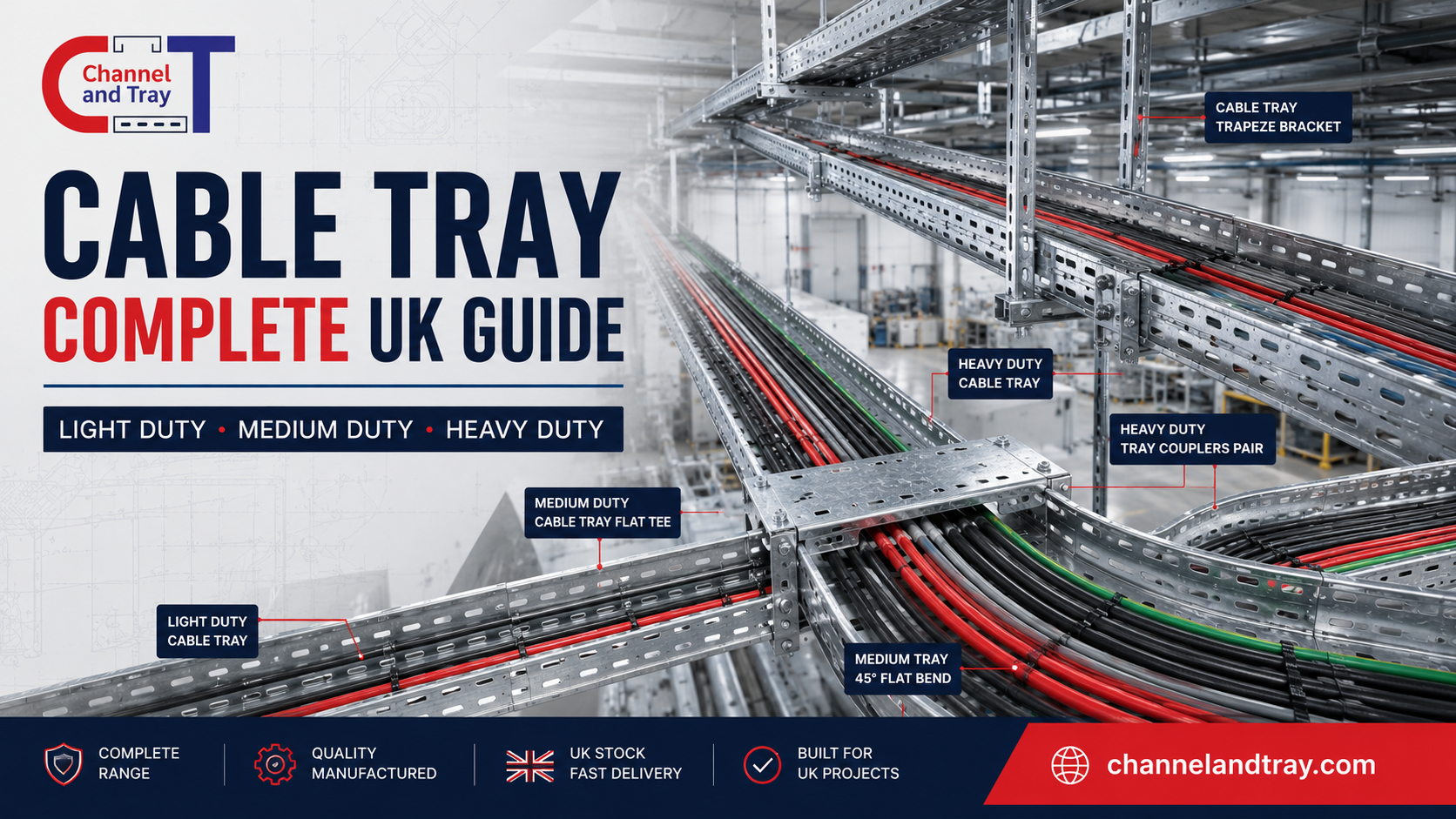
Cable Trays are open or perforated metal supports that carry bundles of cables along a defined route. They allow airflow around cables, making them ideal for environments where heat dissipation is important. Cable trays come in several load ratings — light duty, medium duty, and heavy duty — to suit different environments and cable volumes.
Metal Trunking is an enclosed channel, usually rectangular, that completely covers the cables running through it. This makes trunking ideal for areas where cables need protection from physical damage, dust, or where a neater aesthetic finish is required — such as offices, schools, and commercial properties.
Both systems are available with a full range of fittings including bends, tees, and couplers to handle direction changes and junctions cleanly.
Light Duty Cable Tray — Where & When to Use It
What Is a Light Duty Cable Tray?
A Light Duty Cable Tray is designed for installations where cable loads are relatively low and the environment is not particularly demanding. These trays are typically used in:
- Commercial office buildings
- Retail environments
- Schools and educational facilities
- Residential developments with multiple cable runs
- Data and communications cabling in low-load areas
Common Questions About Light Duty Cable Tray
How much weight can a light duty cable tray hold? Light duty trays are generally rated for lighter cable bundles. They are not suitable for heavy industrial cabling or environments where significant mechanical loads are expecte.
Can light duty cable trays be used outdoors? Some light duty trays are available with galvanised or coated finishes suitable for outdoor use, but always check the specification for your environment.
What sizes are available? Light duty trays are available in a range of widths to accommodate different numbers and sizes of cables.
For straightforward, cost-effective cable management in lighter-duty environments, the light duty range from channel and tray offers excellent value without compromising on quality.
Medium Duty Cable Tray — The Versatile Middle Ground
When a light duty tray is not quite enough but a heavy duty solution would be overkill, Medium Duty Cable Tray fills the gap perfectly. This is the most popular category for a reason — it covers the widest range of applications in both commercial and industrial settings.
Where Is Medium Duty Cable Tray Use?
Cable Tray Medium Duty systems are commonly found in:
- Manufacturing facilities with moderate cable loads
- Warehouses and distribution centres
- Hospitals and healthcare buildings
- Hotels and large commercial developments
- Mechanical and electrical plant rooms
Why Choose Medium Duty?
The medium duty range offers a stronger load-bearing capacity than light duty trays whilst remaining easy to handle and install. It strikes the right balance between robustness and cost-effectiveness, making it the go-to choice for the majority of UK electrical contractors.
Available in multiple widths and finish options, Medium Duty Cable Tray from channelandtray.com is stocked ready for fast UK delivery.
Heavy Duty Cable Tray — Built for Demanding Environments
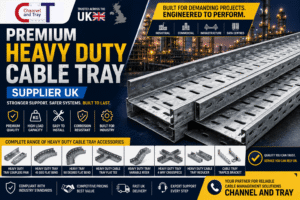
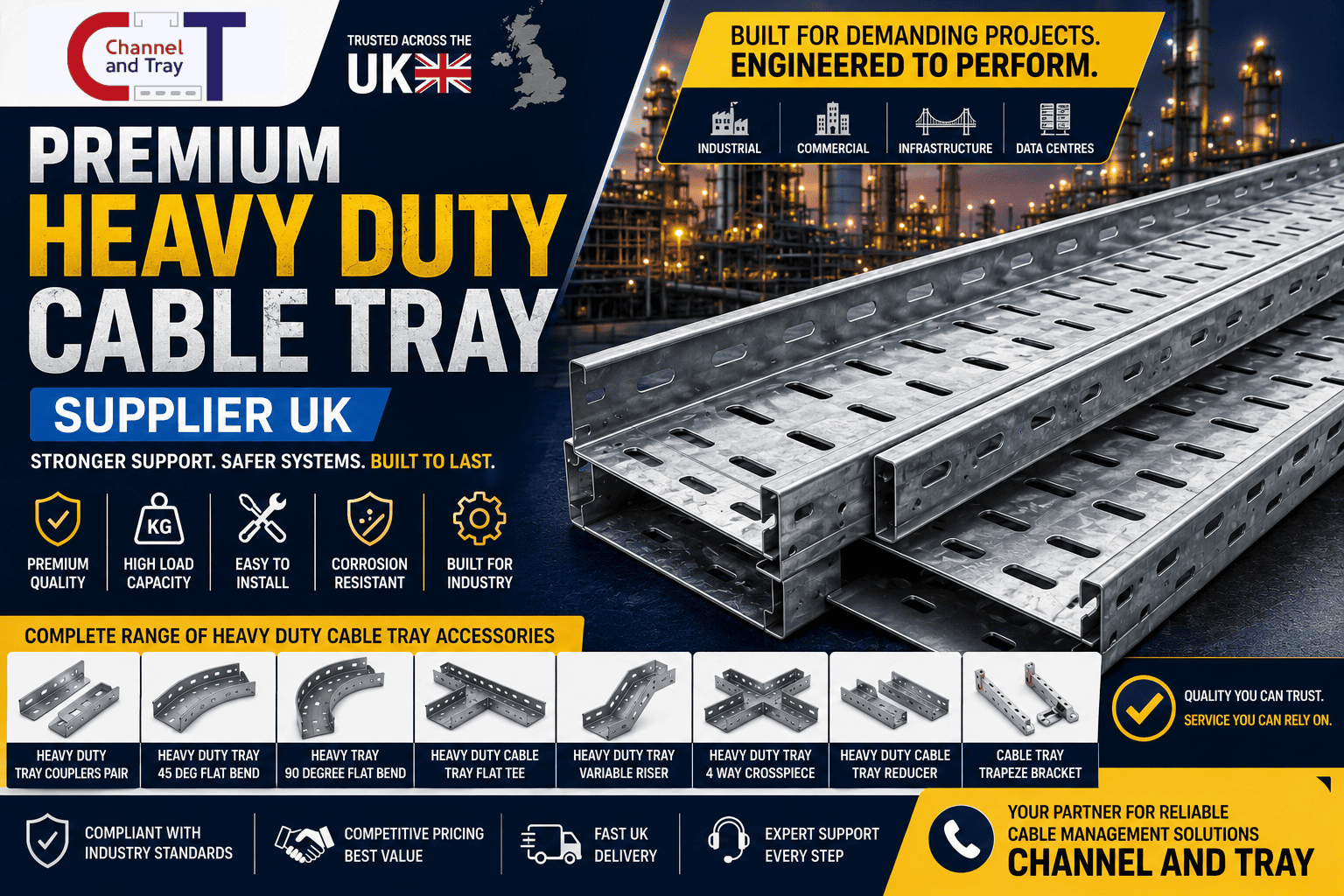
For the toughest installations, Heavy Duty Cable Tray is the only sensible choice. These trays are engineer to carry substantial cable loads in challenging environments where standard trays simply would not perform.
Where Is Heavy Duty Cable Tray Use?
- Power stations and substations
- Oil refineries and chemical plants
- Large industrial facilities
- Data centres with high-density cabling
- Offshore and marine installations
- Underground cable runs
Heavy Duty Tray Couplers Pair
When joining sections of heavy duty tray together, Heavy Duty Tray Couplers Pair provide a secure, reliable connection. These couplers are design to maintain the structural integrity of the tray system across long runs and ensure a continuous, safe cable support route. Using the correct couplers is essential in heavy duty applications — improvise joins introduce weak points that can fail under load.
Heavy Duty Tray 45 Deg Flat Bend
Direction changes in heavy duty installations require purpose-built fittings. The Heavy Duty Tray 45 Deg Flat Bend allows the cable tray run to change direction horizontally at a 45-degree angle without creating sharp bends in the cables themselves. This protects cable integrity and maintains the minimum bend radius required by wiring regulations.
Heavy Duty Cable Tray Flat Tee
Where a cable run needs to branch off in a perpendicular direction, the Heavy Duty Cable Tray Flat Tee provides a clean, structural junction. Rather than attempting to cut and join sections on site — which can compromise safety and neatness — a flat tee fitting ensures a professional finish and a secure, load-bearing connection at every branch point.
Metal Trunking & Bends — Neat, Safe, Professional
Metal Trunking & Bends serve a different purpose to open cable trays. Trunking fully encloses the cables, offering a higher level of physical protection and a cleaner aesthetic finish. This makes it particularly popular in:
- Offices and open-plan workspaces
- Schools, colleges, and universities
- Retail environments
- Healthcare facilities
- Any setting where exposed cables would be unsightly or a safety concern
What Is the Difference Between Cable Tray and Metal Trunking?
The key difference is enclosure. Cable trays are open or perforated — great for heat dissipation and easy cable access but offering less physical protection. Metal trunking is fully enclose, protecting cables from accidental damage, dust, and interference whilst providing a much tidier appearance.
What Are Trunking Bends Used For?
Trunking bends allow the enclosed trunking to change direction — whether horizontally around a corner, vertically up or down a wall, or at an angle. Internal and external bends are available to handle the full range of directional changes that arise in real-world installations.
For clean, professional cable management in commercial and light industrial settings, the Metal Trunking & Bends range at channelandtray.com offers everything you need in one place.
Why Choose Channel and Tray for Cable Management?
When it comes to sourcing cable trays, trunking, strut channel, and fittings in the United Kingdom, channel and tray has established itself as one of the most trusted and competitive suppliers in the industry.
Here is why electrical contractors, facilities managers, and construction professionals across the UK choose Channel and Tray:
- Comprehensive product range — From Light Duty Cable Tray through to Heavy Duty Cable Tray Flat Tees and Metal Trunking & Bends, everything is available in one place. No need to source components from multiple suppliers.
- Competitive UK pricing — channel and tray is commite to offering some of the most affordable prices on cable management products in the UK, without compromising on quality or compliance.
- Fast UK delivery — With stock held ready for despatch, orders can be fulfill quickly to keep your project on schedule.
- Quality you can rely on — All products meet the relevant UK and European standards, giving you confidence in every installation.
- Easy Online Ordering — The website makes it straightforward to find exactly what you need, whether you are sourcing a full system or a handful of fittings.
Whether you need a single box of couplers or a complete cable management system for a large commercial project. Channel and Tray has the products, the stock, and the pricing to support you.
Choosing the right cable management system is not just about tidiness — it is about safety, compliance, longevity, and the professional quality of your installation. Whether you opt for a Light Duty Cable Tray for a straightforward commercial fit-out, a Medium Duty Cable Tray system for a more demanding environment, or a full Heavy Duty Cable Tray installation with couplers, flat bends, and flat tees, using the correct products makes a genuine difference.
Add Metal Trunking & Bends where enclosed protection and a clean aesthetic are needed, and ensure every direction change and junction uses the right fitting for the job.
Explore the complete range of cable trays, trunking, strut channel, and fittings at channel and tray — your reliable UK source for professional cable management products at competitive prices.
Common Questions People Ask About Cable Trays
- What is the difference between light, medium, and heavy duty cable tray?
The primary difference is load-bearing capacity and material thickness. Light duty trays are suitable for low cable volumes in commercial environments. Medium duty trays handle greater loads and suit a wider range of applications. Heavy duty trays are engineer for the most demanding industrial and power installations.
- Do cable trays need to be earthed?
Yes. In most UK installations, metal cable trays form part of the earthing system and must be bond correctly in accordance with BS 7671 (the IET Wiring Regulations). Always consult a qualified electrician if you are unsure about earthing requirements.
- Can cable trays be use outside?
Yes, provided you select the correct finish. Hot-dip galvanised trays offer excellent corrosion resistance for outdoor and exposed environments. Stainless steel options are available for particularly aggressive environments.
- How do I join sections of cable tray together?
Sections are joined using couplers — such as the Heavy Duty Tray Couplers Pair for heavy duty applications. Couplers should always be used rather than improvise joins to maintain structural integrity and electrical continuity.
- What width of cable tray do I need?
Tray width depends on the number and diameter of cables you need to accommodate, plus a spare capacity allowance for future additions. As a general rule, cables should not be stack more than three layers deep. The tray should not be filled beyond 75% of its capacity to allow for heat dissipation and future additions.
- Is metal trunking better than cable tray?
Neither is universally better — they suit different applications. Cable tray is better for large cable volumes, heat-generating cables, and industrial environments. Metal trunking is better where a neat, or where cables need protection from physical damage.