Ask any experienced electrician in the UK what separates a good installation from a great one, and they will tell you the same thing — it is not just about the cables. It is about how well you protect them.
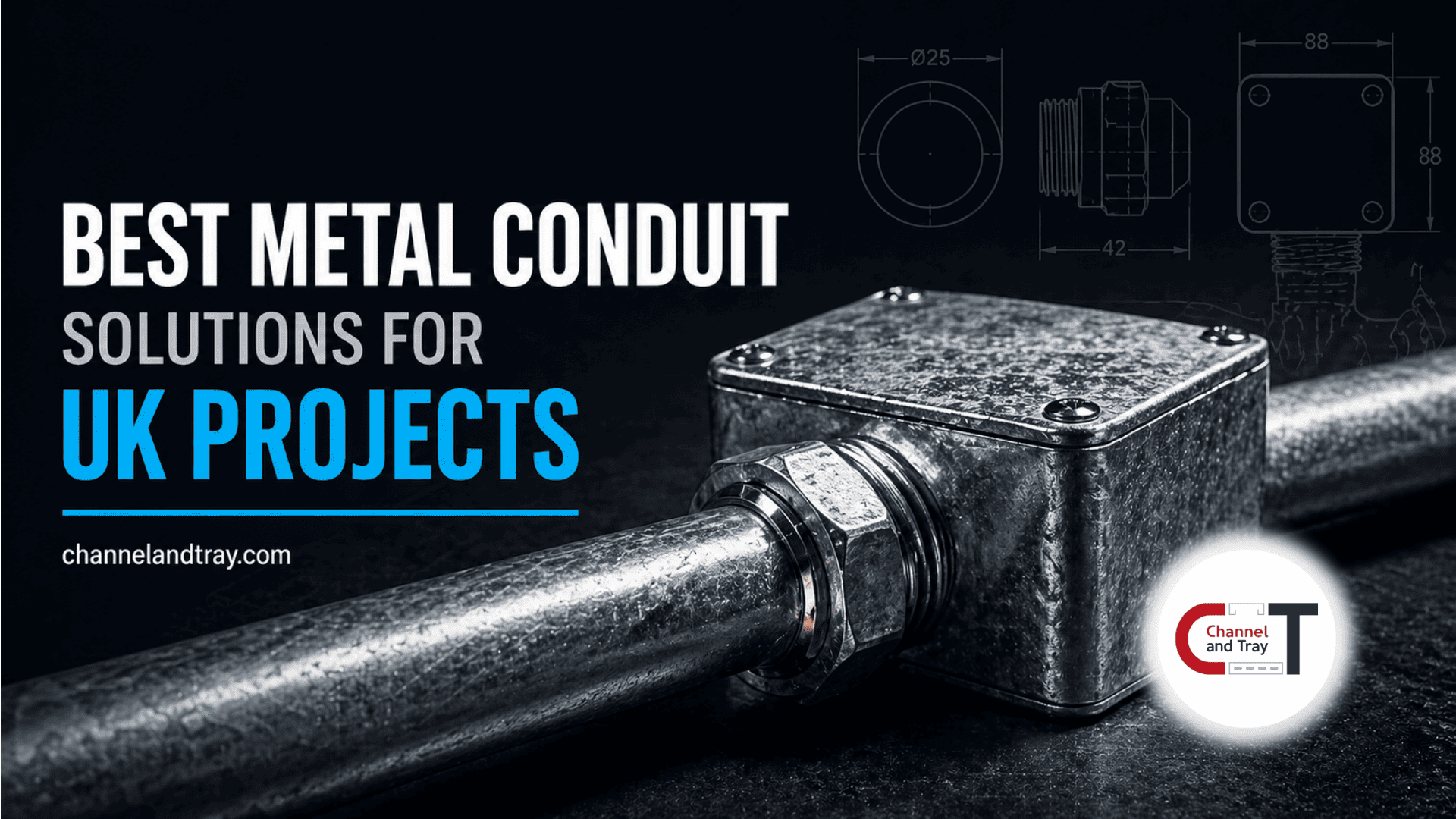
Metal conduit has been the professional’s choice for cable protection in the UK for decades, and for good reason. Whether you are working on a school refurbishment in Leeds, fitting out a manufacturing facility in the Midlands, or running exposed cabling on a commercial building in London, metal conduit delivers a level of mechanical protection, fire resistance, and long-term reliability that plastic simply cannot match.
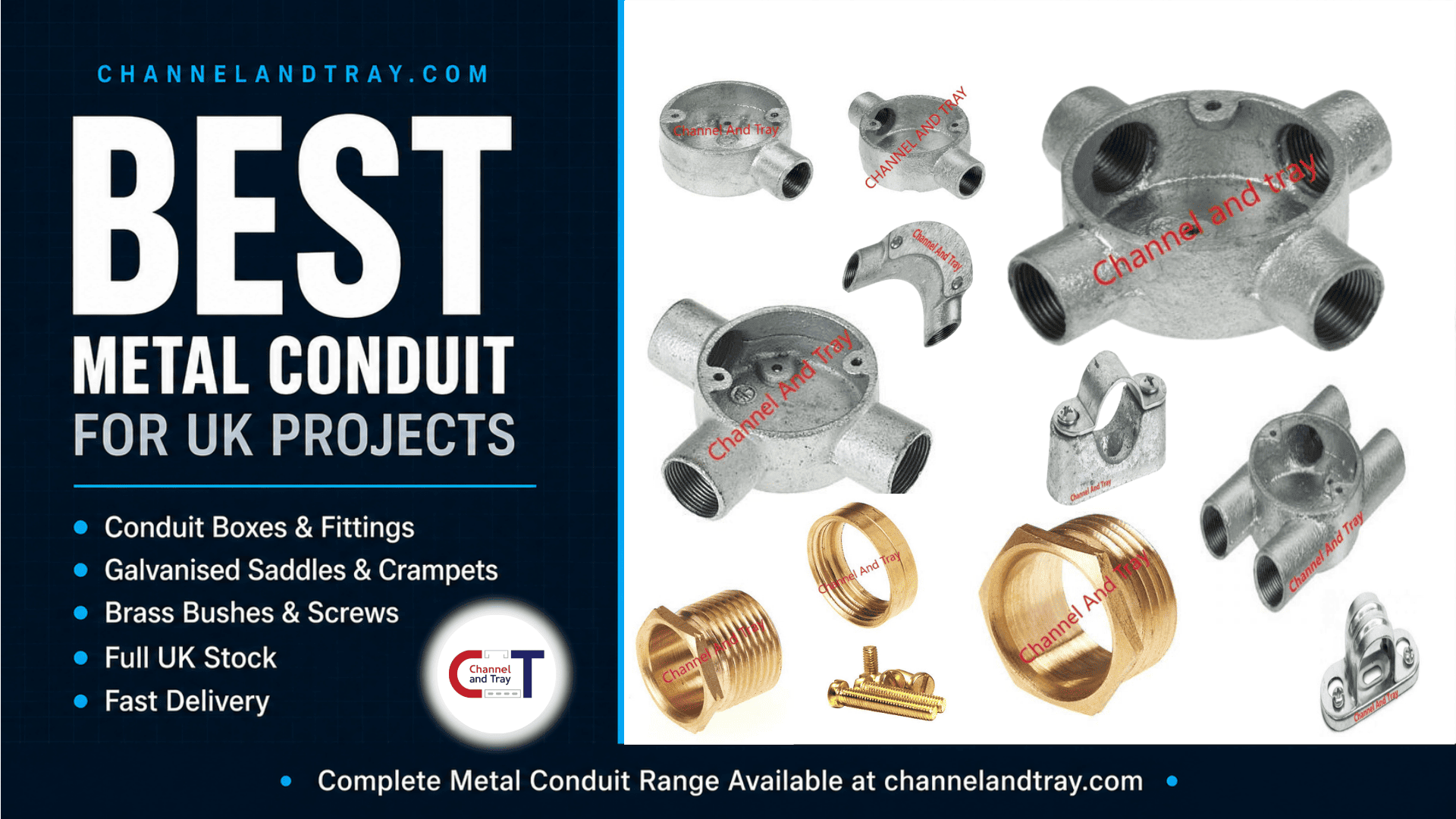
At channel and tray, we supply a comprehensive range of metal conduit products and accessories for UK electricians, contractors, and engineers — from galvanised conduit boxes and saddles through to brass bushes and fixing screws. Everything you need to complete a professional, compliant installation, all in one place.
This guide covers the full metal conduit range, explains what each product does and where it is used, and answers the questions that electricians and contractors across the UK ask most often.
What Is Metal Conduit & Why Do UK Electricians Still Rely on It?
Metal conduit is a rigid or flexible tube — typically manufactured from galvanised steel — used to route and protect electrical cables in a wide range of installation environments. Cables run through the inside of the conduit, which shields them from mechanical damage, moisture, fire, and interference.
Despite the growth of plastic conduit and other cable management systems, metal conduit remains the first choice for many UK professionals. Here is why.
- Mechanical protection. Steel conduit is tough. It protects cables from impact, crushing, drilling, and accidental damage in a way that plastic alternatives simply cannot. In any environment where cables are exposed or at risk of physical damage, metal conduit is the sensible specification.
- Fire performance. Steel does not burn. In the event of a fire, metal conduit helps contain cables and slows the spread of fire through a building — an important consideration in commercial, industrial, and public buildings where fire safety regulations are stringent.
- Earthing capability. A properly installed metal conduit system can form part of the earthing arrangement for the installation — a significant practical and compliance advantage that plastic conduit does not offer.
- Compliance with BS 7671. Metal conduit installations, when correctly specified and installed, fully comply with the IET Wiring Regulations (BS 7671), which govern all fixed electrical installations in the UK.
In short, if you want an installation that is tough, safe, compliant, and built to last — metal conduit is hard to beat.
Types of Metal Conduit Boxes & Their Uses
Conduit boxes are the junctions, terminations, and access points of any metal conduit system. Choosing the right box for each location is essential — get it wrong and you create problems with access, cable routing, and compliance.
Galv Conduit 1 Way Terminal Box
The Galv Conduit 1 Way Terminal Box is used at the end of a conduit run — wherever a conduit terminates at a piece of equipment, a socket, a switch, or a panel. It provides a clean, secure termination point with one conduit entry.
Typical applications include terminating conduit runs at distribution boards, luminaire positions, socket outlets, and any point where cables leave the conduit and connect to equipment. The galvanised finish ensures durability in both internal and moderately exposed environments.
Galv Conduit 2 Way Angle Box
When a conduit run needs to change direction — typically at a right angle — the Galv Conduit 2 Way Angle Box is the correct solution. It provides two conduit entries at 90 degrees to each other, allowing the run to turn a corner cleanly without bending the conduit itself.
This box is particularly useful in installations where tight corners or structural constraints make bending conduit on site impractical. It also provides an accessible inspection point at the change of direction — always useful for future maintenance or cable additions.
Galv Conduit U Box
The Galv Conduit U Box is a three-entry box — one entry on each of three sides — making it ideal for junction points where conduit runs meet or branch off in multiple directions. The U configuration gives you flexibility in how conduit enters the box, and the removable lid provides easy access for cable pulling and inspection.
You will find U boxes wherever conduit runs need to be joined, inspected, or where additional cables need to be introduced to an existing run. They are a staple of any well-planned metal conduit installation.
Galv Conduit Y Box
The Galv Conduit Y Box is used where a conduit run needs to branch at an angle rather than at a straight junction. The Y configuration — with entries arranged in a Y shape — allows conduit to split off in a diagonal direction, which is particularly useful where space is limited or where the conduit layout dictates an angled branch rather than a perpendicular one.
Y boxes are common in complex conduit installations where multiple runs converge and space constraints make straight junctions impractical.
Conduit Fixing & Support Accessories Explained
Getting your conduit boxes right is only half the job. How you fix and support the conduit along its run is equally important — for both compliance and practicality. Here is what you need to know about the fixing accessories available at channel and tray.
Galv Conduit Distance Saddle
The Galv Conduit Distance Saddle is designed to hold the conduit away from the mounting surface — typically a wall or ceiling — at a set distance. This spacing is important for several reasons.
First, it allows air to circulate around the conduit, which helps with heat dissipation from the cables inside. Second, it makes painting and maintenance of the surface behind the conduit far easier. Third, in damp or wet environments, it prevents moisture from becoming trapped between the conduit and the surface — which would accelerate corrosion.
Distance saddles are widely used in industrial facilities, plant rooms, and anywhere that conduit is installed on damp or potentially wet surfaces.
Galv Conduit Spacer Bar Saddles
Where multiple conduit runs need to be secured neatly alongside each other, Galv Conduit Spacer Bar Saddles are the practical solution. These saddles incorporate a spacer bar that keeps adjacent conduits at a consistent distance from each other and from the mounting surface, creating a neat, organised, and professional appearance.
Spacer bar saddles are particularly common in plant rooms, electrical risers, and anywhere multiple conduit runs travel parallel to each other over a significant distance. They give installations a clean, structured look and make future access and identification of individual runs much easier.
Galv Conduit Crampet
The Galv Conduit Crampet is one of the simplest and most widely used conduit fixing accessories. It secures the conduit directly against the mounting surface — wall, ceiling, or structural element — holding it firmly in place along its run.
Crampets are used wherever conduit needs to be fixed flush to a surface without the standoff distance provided by a distance saddle. They are quick to install, reliable, and suitable for the vast majority of standard conduit fixing applications.
One question that comes up regularly is why we should use the correct fixing accessory instead of improvising with cable ties or other fixings. The answer is straightforward. Correct fixings are designed to support the conduit at the right intervals. They maintain the conduit’s position under mechanical stress. Additionally, they ensure that the installation complies with BS 7671 requirements for conduit support spacing.
Brass Bush & Fittings — Why the Small Parts Matter Most
Here is something that experienced electricians know but newer installers sometimes overlook — the small fittings matter just as much as the conduit itself. Using the wrong bush or the wrong screw might seem like a minor issue, but it can result in damaged cables, failed inspections, and costly remediation work.
Female Brass Bush
The Female Brass Bush is fitted at the entry and exit points of conduit — wherever cables pass from inside the conduit to outside, or into equipment. Its purpose is simple but critical: it protects the cable insulation from the sharp edges of cut conduit ends.
Without a proper bush, cable insulation can be abrade against raw metal edges over time — particularly where cables move due to vibration or thermal expansion. This leads to insulation breakdown, short circuits, and potentially dangerous faults. Brass is use because it is non-ferrous, corrosion-resistant, and soft enough not to damage cable insulation whilst being durable enough to last the life of the installation.
Short Brass Bush
The Short Brass Bush serves the same cable protection purpose as the female brass bush. However, it does so in a lower-profile format. It is use where there is limited clearance at the conduit entry point. For example, this situation arises where conduit terminates very close to a piece of equipment. It is also applicable within a compact enclosure where a standard-length bush would protrude too far.
Specifying the correct length of bush for the application is important. This small detail makes a noticeable difference to the neatness and quality of the finished installation.
Long Brass Bush
The Long Brass Bush is use where deeper thread engagement is require. This is typically necessary when conduit terminates through a thicker surface or panel. It is also need where additional protection length is require to keep cables clear of sharp metal edges over a longer entry distance.
Long brass bushes are commonly specified in industrial switchgear. They are also use in distribution boards with thicker enclosure walls. Additionally, they are employe anywhere the standard short bush would not provide sufficient coverage.
M4 Brass Pan Head Screw
The M4 Brass Pan Head Screw is use to secure conduit fittings, boxes, and accessories. Brass is specified instead of standard steel screws. This is because brass is non-ferrous. Therefore, it will not corrode like steel in damp or humid environments. Additionally, brass avoids galvanic corrosion issues. These issues can arise when dissimilar metals are in contact in moist conditions.
Using the correct fixing screw is a mark of a professional installation.
Where Is Metal Conduit Used in UK Projects?
Metal conduit turns up in a remarkably wide range of UK electrical installations. Here are the environments where it is most commonly — and most importantly — specified.
- Industrial facilities. Factories, manufacturing plants, and warehouses are arguably where metal conduit earns its reputation most. Mechanical damage from fork-lift trucks, machinery, and general industrial activity makes robust cable protection essential. Metal conduit handles it.
- Commercial buildings. Offices, retail units, and mixed-use developments often use metal conduit. This is common in plant rooms, risers, and service areas. It’s use anywhere cables need to be neatly route and protect. The goal is to avoid hiding them within the building fabric.
- Schools and educational buildings. Metal conduit is widely used in schools and colleges, particularly in areas where cables are exposed and accessible. Its durability and compliance credentials make it a natural fit for public buildings with strict safety requirements.
- Hospitals and healthcare facilities. In healthcare environments, fire performance and reliability are paramount. Metal conduit’s non-combustible nature and earthing capability make it a preferred choice in many hospital electrical installations.
- External and exposed installations. With the correct galvanised finish, metal conduit performs well in external environments. It is ideal for car parks, covered walkways, and plant areas. It protects cables from the elements and physical damage.
- Hazardous areas. Hazardous environments under ATEX regulations include petrol stations, chemical plants, and grain stores. Metal conduit is often require for compliant cable installations in these areas.
Why Buy Metal Conduit from Channel and Tray?
When it comes to sourcing metal conduit and accessories in the UK, channel and tray makes it straightforward.
Here is what you get when you order from Channel and Tray:
- Complete product range — Every conduit box type, every saddle, every brass bush, and every fixing screw you need — all available from one supplier. No hunting around multiple trade counters or websites.
- Competitive UK pricing — channelandtray.com is committed to offering some of the most affordable prices on metal conduit products in the UK. Professional quality does not have to mean inflated prices.
- Fast UK delivery — Stock held ready for despatch. Whether you need product for a job starting tomorrow or you are planning ahead for a larger project, orders are processe and despatch quickly to keep you on schedule.
- Quality you can rely on — All products meet relevant UK and European standards. Every fitting, every saddle, every bush — specified and tested for professional electrical installation use.
- Easy online ordering — The product range is clearly organised and easy to navigate. Find exactly what you need, add to basket, and order — without the delays of waiting for a trade counter to open or chasing a sales rep for a quote.
Browse the full metal conduit range at channel and tray and see everything that is available to order today.
Metal conduit has proven reliable in UK electrical installations. It protects cables effectively and performs well under pressure. It also meets the compliance standards required for professional installations.
Choosing the right products is crucial for any installation. Whether it’s a simple commercial fit-out or a complex industrial setup, details matter. Use the right conduit box at each junction, the right saddle at every fixing point, and the right brass bush for each cable entry. These details ensure a compliant and professional installation, avoiding future problems.
Browse the complete metal conduit range. This includes all boxes, saddles, bushes, and accessories. Visit Channel and Tray to find the right products for your next UK project. You’ll find prices that work for your budget.
FAQs
- What is the difference between metal and plastic conduit?
Metal conduit offers superior mechanical protection, fire resistance, and earthing capability compared to plastic. Plastic conduit is lighter, easier to cut, and lower in cost — making it suitable for domestic and light commercial applications. For industrial, exposed, or high-risk environments, metal conduit is the professional specification.
- Can metal conduit be use outdoors in the UK?
Yes. Galvanised metal conduit is suitable for outdoor use if installed correctly. Ensure all fittings and accessories match the exposure level. For harsh environments, like coastal or chemical areas, consider using additional protection or stainless steel alternatives.
- Does metal conduit need to be earth?
Metal conduit installations must be properly bond and earth in accordance with BS 7671. In many installations, the conduit system itself forms part of the circuit protective conductor — but this must be verified by a qualified electrician. Never assume the conduit provides adequate earthing without proper verification.
- What size metal conduit do I need?
Conduit size is based on the number and area of cables, plus the fill factor per BS 7671. Standard UK sizes are 16mm, 20mm, 25mm, and 32mm. Always calculate conduit fill to avoid overfilling.
- What accessories do I need to complete a metal conduit installation?
A complete installation typically requires: conduit boxes (terminal, angle, U, or Y as appropriate), distance saddles or crampets. For fixing, spacer bar saddles for multiple runs, brass bushes at all entry and exit points, and brass screws for securing fittings. Channel and tray stocks the complete range so you can source everything from a single supplier.
- What is the best place to buy metal conduit in the UK?
For competitive pricing, fast delivery, and a comprehensive product range, channel and tray is one of the UK’s most trusted online suppliers. Browse the full metal conduit range at