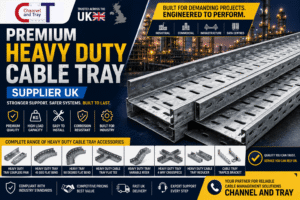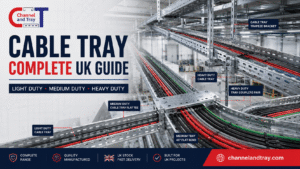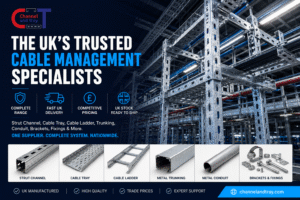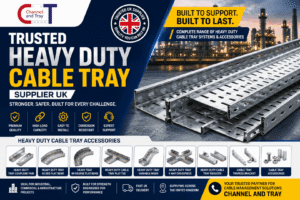
There is a point in every large-scale UK industrial project where the cable schedule lands on your desk and the sheer volume and weight of power cables makes one thing immediately clear — you are going to need cable ladder.
Not cable tray. Not trunking. Cable ladder.
Whether you are managing the electrical installation in a new manufacturing plant in the Midlands, specifying cable routes through a data centre in the South East, or working on a major infrastructure project anywhere in the UK, cable ladder is the system that handles what everything else cannot. Large diameter cables. Heavy loads. Long unsupported spans. Environments where nothing less than a robust, open, industrial-grade support system will do.
At channel and tray, we supply a comprehensive range of cable ladder systems and accessories for UK industrial and commercial projects — from medium duty ladder sections and directional fittings through to hold down clips and trapeze brackets. This guide covers everything you need to know about cable ladder, from what it is and where it is used, through to every fitting and accessory in the range.
What Is Cable Ladder & Cable Tray?
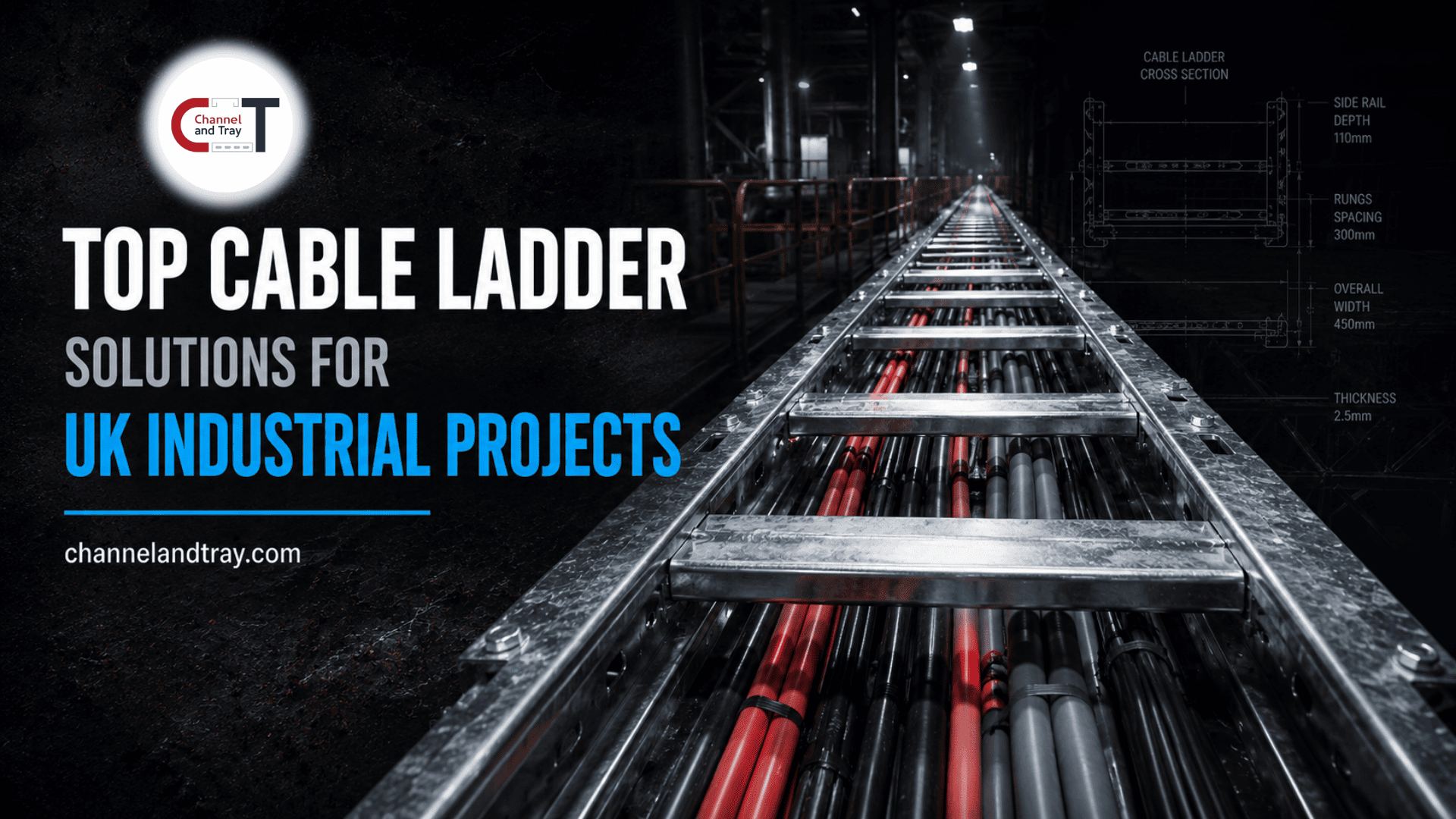
Cable ladder is exactly what it sounds like — a ladder-shaped cable support system consisting of two parallel side rails connected by a series of evenly spaced rungs. Cables sit on and between the rungs, held in place by their own weight and, where required, by hold down clips.
That open rung construction is what sets cable ladder apart from cable tray — and it is not just a cosmetic difference.
- Load capacity. Cable ladder is engineered to carry significantly heavier cable loads than standard cable tray. The side rail and rung construction distributes load more effectively across longer spans, making cable ladder the correct specification for the heaviest cable runs in any installation.
- Span capability. One of cable ladder’s biggest practical advantages is its ability to span greater distances between supports. Where cable tray typically requires supports at relatively short intervals, cable ladder can span considerably further — reducing the number of support structures needed and simplifying installation in large industrial spaces.
- Airflow and heat dissipation. The open rung construction allows unrestricted airflow around cables. In installations carrying large power cables that generate significant heat under load, this ventilation is not just convenient — it is essential for maintaining cables within their rated operating temperature and ensuring the installation complies with current-carrying capacity requirements under BS 7671.
- Ease of cable installation. Laying cables into an open ladder system is considerably easier than pulling them through enclosed trunking or threading them through conduit. In large industrial installations where cable runs are long and cable volumes are high, that ease of installation translates directly into reduced labour time and cost.
When to specify cable ladder over cable tray:
- Large diameter power cables — 95mm² and above
- High cable volumes requiring open access for heat dissipation
- Long unsupported spans in large industrial buildings
- Heavy total cable loads exceeding cable tray capacity
- Environments where future cable additions are anticipated
In short, cable tray handles the majority of commercial and light industrial cable management requirements. Cable ladder handles the rest — and it handles them reliably.
Where Is Cable Ladder Used?
Cable ladder turns up wherever the cable management demands are at their most serious. Here is a cross-section of the UK environments where it is most commonly and most importantly specified.
- Power stations and substations. The cable volumes and cable sizes involved in power generation and distribution make cable ladder the only practical support system. Hundreds of metres of large-format power and control cables, running at heights and across spans that would be impossible with standard cable tray.
- Oil, gas, and petrochemical facilities. These environments demand robust cable support systems that can handle heavy loads, resist corrosion, and perform reliably in potentially hazardous atmospheres. Cable ladder — typically in hot-dip galvanised or stainless steel finish — is the default specification.
- Data centres. Modern hyperscale data centres carry extraordinary volumes of power and data cable. Cable ladder systems running overhead throughout the white space provide the load capacity and open access needed to manage these installations efficiently, with the ability to add cables easily as the facility grows.
- Manufacturing and automotive plants. Factory floors generate large cable runs for machinery, drives, control systems, and power distribution. Cable ladder provides the structural support and accessibility these installations need.
- Chemical and pharmaceutical processing. Corrosive atmospheres, washdown environments, and the need for absolute reliability make cable ladder — in appropriate material and finish — the specification of choice.
- Tunnels and underground infrastructure. Road tunnels, rail tunnels, and utility tunnels across the UK use cable ladder for the main cable routes — the span capability and load capacity are essential in these long, continuous runs.
- Large commercial buildings. Major commercial developments — airports, hospitals, shopping centres — often use cable ladder in plant rooms, risers, and large horizontal runs where cable volumes exceed what standard cable tray can reliably handle.
Wherever the installation is demanding, the cables are heavy, and the runs are long — cable ladder is where the specification conversation starts.
Medium Duty Cable Ladder
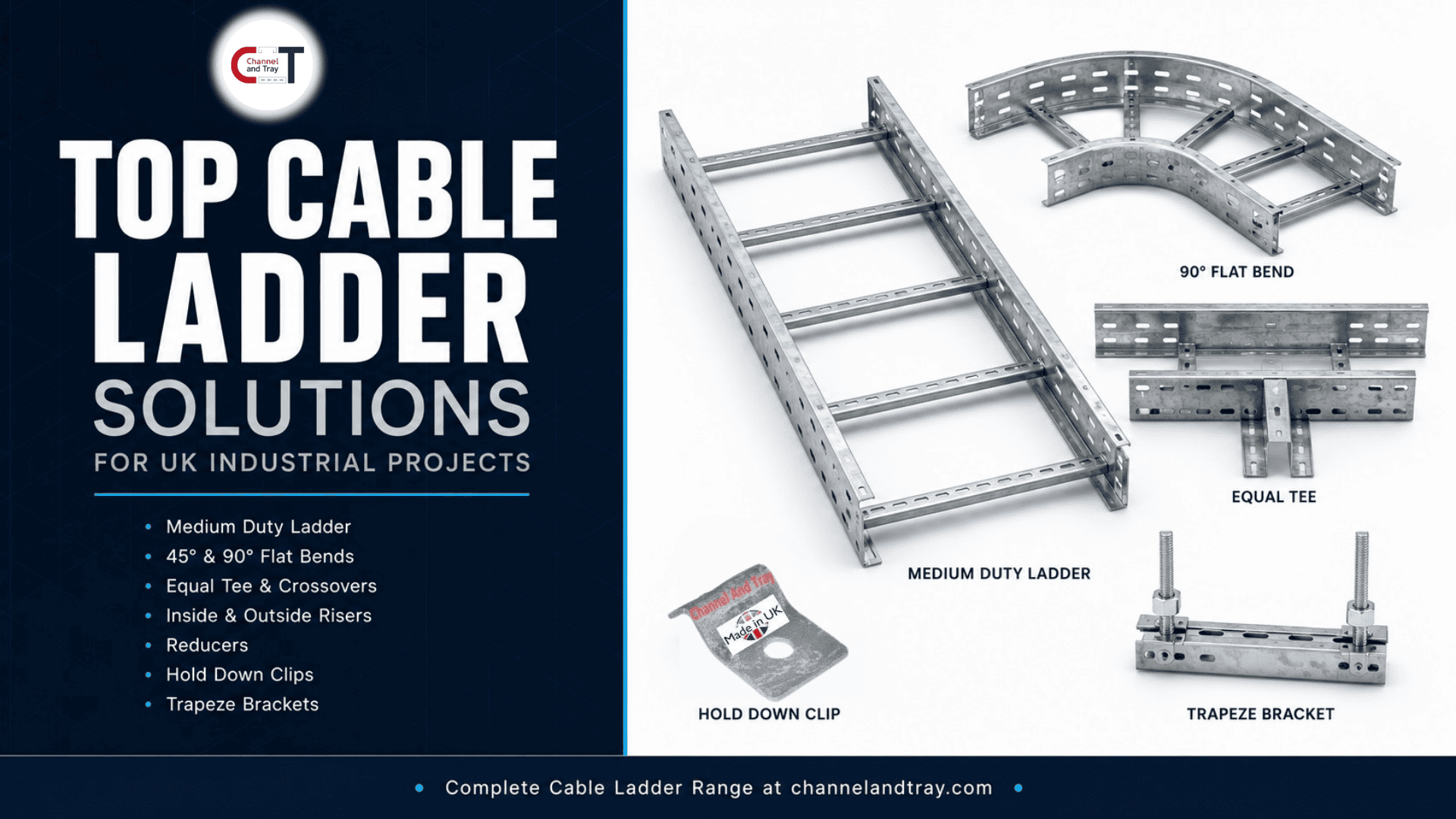
If you work in UK M&E contracting, you will know that the Medium Duty Ladder is the workhorse of the cable ladder range. It is the most widely specified type for good reason — it hits the sweet spot of load capacity, span capability, and cost that makes it suitable for the vast majority of UK industrial and heavy commercial applications.
What makes medium duty ladder the right choice?
Medium duty cable ladder is manufactured from steel — typically in a hot-dip galvanised finish for corrosion resistance — with a rung and side rail construction that provides substantial load-bearing capacity across typical installation spans. It is robust enough for serious industrial use whilst remaining practical to handle, cut, and install on site.
Typical applications for medium duty cable ladder:
- Main cable routes in manufacturing facilities
- Power cable distribution in data centres
- Overhead cable runs in warehouses and logistics facilities
- Primary cable management in hospitals and large healthcare buildings
- Cable support in water treatment and utilities infrastructure
- Main distribution routes in large commercial developments
When is medium duty the right specification?
Medium duty is the correct choice when your cable load and span requirements exceed what standard cable tray can handle, but do not require the additional structural capacity of heavy duty ladder. For the majority of UK industrial electrical installations, medium duty ladder will be the correct specification — it covers the widest range of practical applications and is the most readily available option in the UK market.
Browse the full Medium Duty Cable Ladder range at channelandtray.com, including all fittings and accessories.
Cable Ladder Fittings
A cable ladder system is only as good as its fittings. Straight sections are straightforward — it is at the bends, junctions, risers, and crossovers that installations either come together professionally or start to unravel.
Here is every fitting you need to know about.
45 Deg Flat Bend for Medium Duty Cable Ladder
The 45 Deg Flat Bend for Medium Duty Cable Ladder allows the cable ladder run to change direction horizontally at a 45-degree angle. This fitting is used wherever the cable route needs to follow a diagonal path — navigating around structural columns, following the geometry of a building, or routing cables diagonally between two parallel routes.
Without the correct 45-degree bend fitting, the alternative is forcing cables around a sharp corner — which damages insulation, creates stress concentrations, and almost certainly violates the minimum bend radius requirements specified in BS 7671. The fitting exists for good reason. Use it.
90 Deg Flat Bend for Medium Duty Cable Ladder
The 90 Deg Flat Bend for Medium Duty Cable Ladder is the most commonly used bend fitting in any cable ladder installation. It allows the ladder run to change direction horizontally at a full right angle — the standard requirement wherever a cable route turns a corner in the horizontal plane.
Every cable ladder installation of any size will include multiple 90-degree flat bends. Getting the right fitting — matched to the ladder width and duty rating — ensures structural continuity at the bend, protects cable integrity, and gives the installation a professional, compliant finish.
Equal Tee for Medium Duty Cable Ladder
Where a cable ladder run needs to branch off in a perpendicular direction, the Equal Tee for Medium Duty Cable Ladder is the correct fitting. It provides a T-junction in the ladder system — one main run continuing straight ahead, one branch running off at 90 degrees — all in the same structural, matched fitting.
Equal tees are essential in any installation where cable routes fan out from a central spine — distribution boards, main cable routes in large buildings, or anywhere the ladder system needs to serve multiple zones from a single primary run.
Attempting to create a T-junction by cutting and joining ladder sections without the correct fitting results in a structurally weak, untidy, and non-compliant junction. The equal tee fitting does the job properly.
90 Deg Inside Riser for Medium Duty Ladder
When a cable ladder run needs to change direction vertically — transitioning from a horizontal run to a vertical one, or vice versa — a riser fitting is required. The 90 Deg Inside Riser for Medium Duty Ladder handles this vertical direction change on the inside radius of the bend.
In practical terms, the inside riser is used where the cable ladder transitions from horizontal to vertical. The cables on the inside of the bend need support along the shorter radius. Typically where the ladder rises upward from a horizontal run at a wall or structural element.
90 Deg Outside Riser for Medium Duty Ladder
The 90 Deg Outside Riser for Medium Duty Ladder handles the same vertical direction change as the inside riser. However, it does so on the outside radius of the bend. The outside riser is used where the cable ladder descends or rises on the longer radius. The geometry is different from the inside riser. Using the correct fitting for the specific transition is essential for structural integrity. It also ensures correct cable support through the bend.
Both inside and outside risers are essential components of any cable ladder installation that changes level. Most serious industrial installations do involve these changes. Therefore, specify both where needed.
Crossover for Medium Duty Cable Ladder
In complex industrial installations where multiple cable routes run in different directions, cable ladder runs sometimes need to cross each other. The Crossover for Medium Duty Cable Ladder is the fitting that makes this possible cleanly and structurally.
The crossover fitting allows one cable ladder run to pass over another at 90 degrees. This maintains the structural integrity of both runs. It also keeps cables separated and organized. Additionally, it avoids the kind of improvised crossing that can create structural weak points and cable management chaos.
Crossover fittings are particularly common in data centers, power stations, and large manufacturing facilities. In these environments, the volume and complexity of cable routes often make crossed ladder runs inevitable.
Reducer for Medium Duty Cable Ladder
As cable routes progress through a building, the number of cables in any given run typically decreases as individual circuits branch off to their destinations. The Reducer for Medium Duty Cable Ladder allows the ladder to transition from a wider section to a narrower one — matching the ladder width to the actual cable volume at each point in the run.
Using reducers correctly is good engineering practice. Oversized ladder where it is not needed wastes material and money. Undersized ladder where cable volumes are high creates overloading and compliance problems. The reducer fitting allows the system to be correctly sized throughout — wide at the main distribution points, narrowing as routes fan out.
Cable Ladder Support & Fixing Accessories
Fittings handle the direction changes and junctions. Accessories handle the equally important job of keeping cables secure and the entire system properly supported.
Hold Down Clip for Medium Duty Ladder
The Hold Down Clip for Medium Duty Ladder is a simple but essential component. It secures individual cables or cable bundles to the rungs of the ladder, preventing them from lifting, shifting, or moving under the mechanical forces that arise in real-world installations.
Why are hold down clips essential?
Cables on a cable ladder are subject to various forces. These forces can cause the cables to move. Thermal expansion and contraction occur as they heat up and cool down under load. Vibration from nearby machinery also affects the cables. Additionally, gravitational forces act on cables running on vertical ladder sections. Without hold-down clips, cables can shift position. This shifting can create uneven loading on the ladder. In the worst cases, cables might lift clear of the rungs entirely on bends and risers.
BS 7671 and supporting installation standards require cables to be properly secured to their support systems. Hold down clips are the means by which cable ladder installations meet this requirement. They are not an optional extra — they are a compliance requirement in any properly installed cable ladder system.
Hold down clips are particularly critical at bends, risers, and crossovers. Anywhere the cable route changes direction and gravity or mechanical forces are working against the cable staying in position.
Ladder Trapeze Bracket
The Ladder Trapeze Bracket is the primary means of suspending cable ladder from overhead structure — beams, purlins, concrete soffits, or dedicated support steelwork. Understanding what a trapeze support is and how it works is fundamental to specifying and installing cable ladder correctly.
What is a trapeze support?
A trapeze support consists of a horizontal cross member — in this case the cable ladder itself or a dedicated cross bar — suspended from above by two vertical rods or hangers at either end. The name comes from the resemblance to a trapeze bar. The Ladder Trapeze Bracket is the component that connects the cable ladder to the suspension hanger, forming the critical link between the ladder and the structure it hangs from.
How is a trapeze bracket use in practice?
Threaded rod hangers are fix to the overhead structure at the required spacing along the cable ladder run. The trapeze bracket then connects the cable ladder side rails to these hangers, supporting the ladder at the correct height and maintaining its position along the route.
Why is proper trapeze support critical?
The span between trapeze supports affects the deflection of the cable ladder under load. Exceeding the manufacturer’s recommended support spacing causes excessive deflection. This puts the ladder under stress it wasn’t designed to handle. Ultimately, this can lead to structural failure. Always follow the manufacturer’s span tables. This will help you determine the correct trapeze support spacing for your specific ladder width, duty rating, and cable load.
Trapeze brackets are use in most overhead cable ladder installations. They are commonly found in suspend ceilings in data centers. They are also use for overhead routes in manufacturing facilities. These brackets are utilize when the cable ladder is hung from structural steelwork instead of being wall-mounted.
Why Buy Cable Ladder from Channel and Tray?
When it comes to sourcing cable ladder in the United Kingdom, channel and tray makes the process straightforward from specification through to delivery.
Here is what sets Channel and Tray apart:
- Complete cable ladder range — Medium duty ladder sections in multiple widths, plus every fitting you need: 45-degree and 90-degree flat bends, equal tees, inside and outside risers, crossovers, reducers, hold down clips, and trapeze brackets. Everything from one supplier — no chasing multiple trade counters or waiting on special orders.
- Competitive UK pricing — channelandtray.com is committed to offering some of the most competitive prices on cable ladder products in the UK market. Whether you are sourcing for a single project or placing regular procurement orders, the pricing works for professional trade buyers.
- Fast UK delivery — Stock is held ready for despatch. For time-critical projects where material delays cost money, that matters. Orders are processe and ship quickly to keep your installation programme on track.
- Quality you can rely on — All cable ladder products and fittings meet the relevant UK and European standards. Every component is specified for professional industrial installation use — not budget product that will cause problems down the line.
- Easy online ordering — The full range is clearly organised at channelandtray.com and easy to navigate. Find the product, check the specification, add to basket, and order — without the friction of calling a rep or waiting for a quote.
Browse the complete cable ladder range — sections, fittings, and accessories — at channel and tray
Cable ladder earns its place in the most demanding UK industrial installations. It delivers what nothing else can. It provides the load capacity, the span capability, the airflow, and the open access that serious power cable installations require.
Specifying the system correctly matters. Use a medium-duty ladder for the main runs. Choose the right bend fitting for every direction change. This could be a 45-degree flat bend, a 90-degree flat bend, or a riser. Install an equal tee at every junction. Use a crossover where runs intersect. A reducer is necessary where the cable volume drops. Hold down clips should keep every cable secure. Finally, use ladder trapeze brackets to properly suspend the whole system from the structure above.
Every component has a job. Every fitting matters. And having the right products available from a single, reliable UK supplier makes the whole process considerably easier.
Browse the complete cable ladder range at channel and tray — and get the right system for your next UK industrial project, with competitive pricing and fast UK delivery as standard.
Common Questions People Ask
- What is the difference between cable ladder and cable tray?
Cable tray is a continuous perforated or solid-bottom support that carries cables along its surface. It uses an open rung construction — like a ladder. Which provides greater load capacity, better airflow around cables, and the ability to span longer distances between supports. Cable ladder is specified for heavier cables, higher loads, and more demanding environments where cable tray would be inadequate.
- What span can medium duty cable ladder achieve?
Span capability depends on the ladder width, the total cable load, and the specific product specification. Medium duty cable ladder is capable of significantly longer spans than standard cable tray. Consult the manufacturer’s span tables for your specific width and load combination. Always follow the recommended support spacing to avoid excessive deflection under load.
- Does cable ladder need to be earthed?
Yes. Metal cable ladder forms part of the electrical installation and must be properly bonded and earthed in accordance with BS 7671. In many installations the ladder system forms part of the circuit protective conductor arrangement. Always verify earthing continuity with a qualified electrician. Never assume the ladder provides adequate earthing without proper verification and testing.
- Can cable ladder be use outdoors in the UK?
Yes, provided the correct material and finish is specified. Hot-dip galvanised cable ladder offers good corrosion resistance for outdoor and exposed environments. For coastal locations, chemical exposure, or permanently wet conditions, stainless steel or additional protective finishes should be consider. Always check the product specification against the specific environmental exposure.
- What accessories do I need to complete a cable ladder installation?
A complete cable ladder installation typically requires several components. These include appropriate fittings for all bends, junctions, risers, and crossovers along the route. Hold down clips are need to secure cables at regular intervals and at all direction changes. Trapeze brackets and thread rod hangers are use for suspension from the overhead structure. Splice plates or couplers are essential for joining ladder sections. Additionally, appropriate earthing conductors and bonds are necessary. Channel and tray stocks a complete range of medium-duty cable ladder fittings and accessories.
- How do I suspend cable ladder from a ceiling or structural steelwork?
Cable ladder is suspended using threaded rod hangers fixed to the overhead structure, with Ladder Trapeze Brackets connecting the ladder side rails to the hangers. Support spacing must comply with the manufacturer’s span tables for the specific ladder width and cable load. For concrete soffits, resin or mechanical anchors are use. For structural steelwork, beam clamps provide the fixing point for the threaded rod.
- Where can I buy cable ladder in the UK?
Channel and tray is one of the UK’s most trusted online suppliers of cable ladder, stocking the complete range of medium duty ladder sections, fittings, and accessories with competitive UK pricing and fast delivery. Browse the full range at