Get it right and your installation is safe, compliant, and built to last. Get it wrong and you are looking at rework, failed inspections, and a finish that does not reflect the standard of your work.
The problem is that most guides either oversimplify the choice or drown you in technical data that does not help on a real job. This guide does neither.
We cover every product in the cable trays and trunking range — light duty, medium duty, heavy duty, and metal trunking — with every fitting explained plainly and every common question answered directly.
channel and tray supplies the complete range across all duty ratings and trunking systems, with competitive UK pricing and fast delivery. By the end of this guide, you will know exactly what to order for your next project.
Cable Trays vs Trunking — What Is the Difference?
This is the question every new electrician asks — and plenty of experienced ones still get wrong.
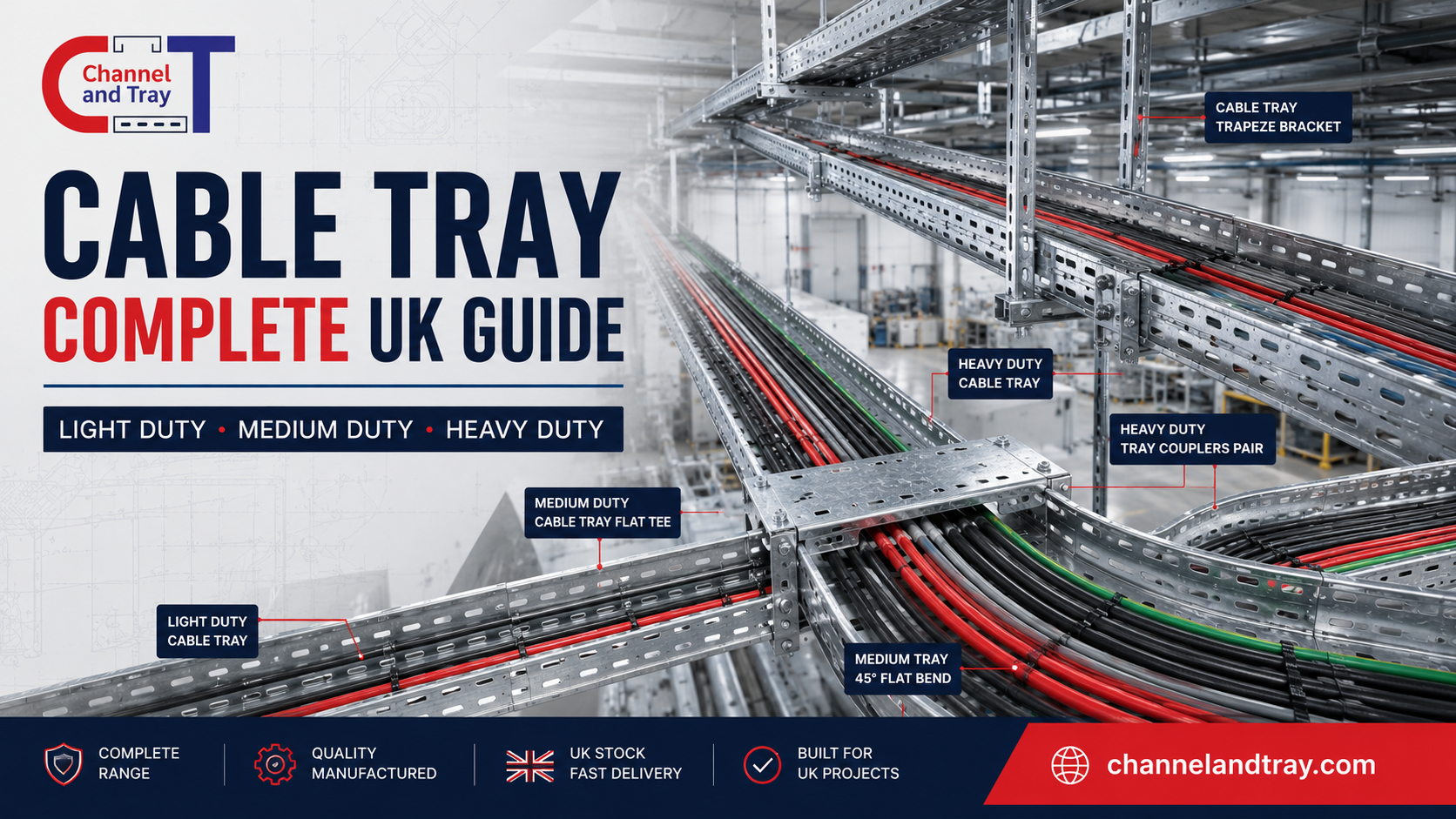
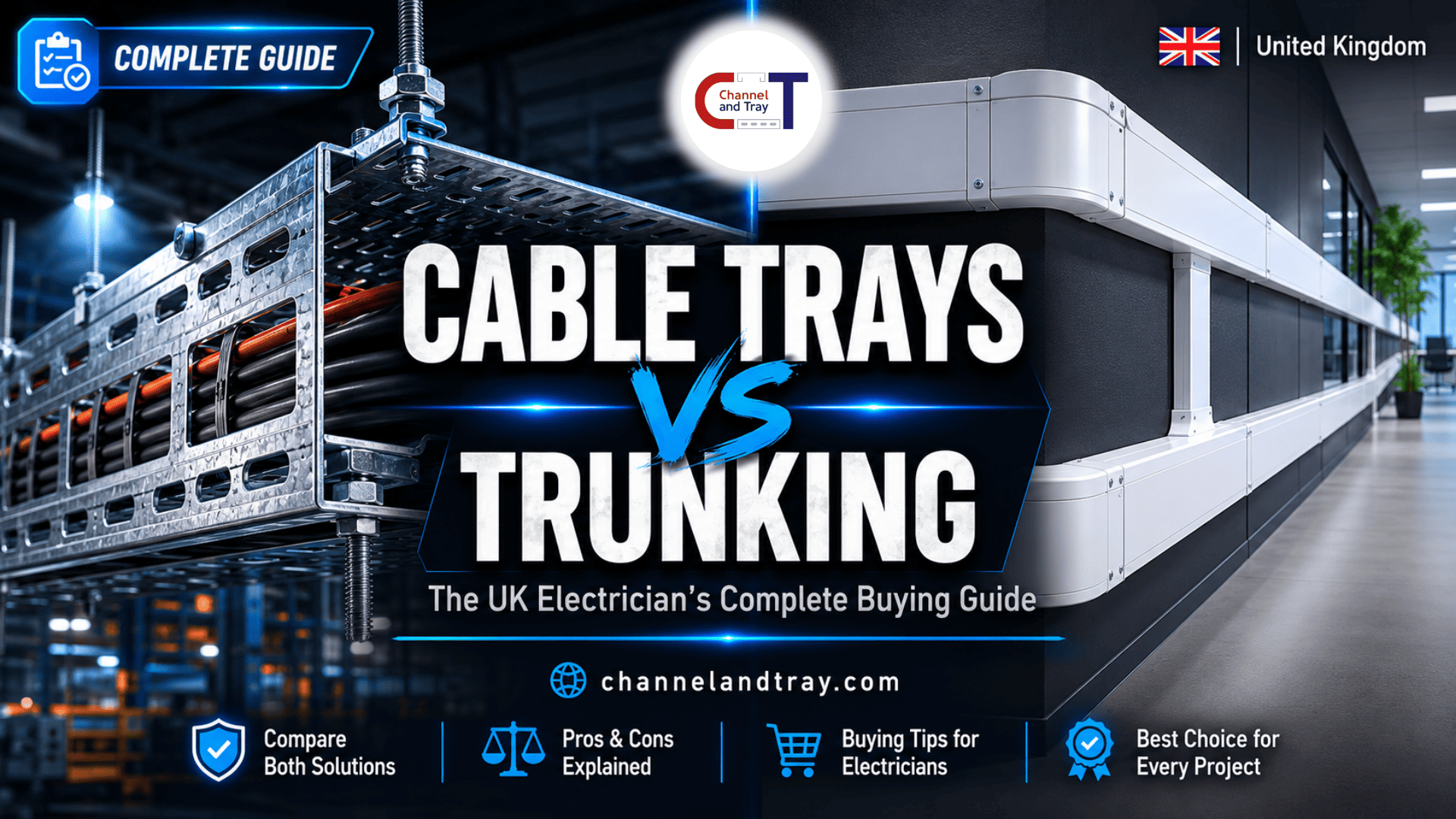
Cable tray is an open or perforated metal support. Cables sit on top and run along its length. Air circulates freely around the cables. Access is easy. Installation is fast.
Metal trunking is an enclosed rectangular channel. Cables run inside it, fully covered by a removable lid. The cables are hidden, protected, and neat.
Both systems manage cables. But they suit different jobs entirely.
Choose cable tray when:
- Cable volumes are high
- Heat dissipation matters
- Access for future changes is a priority
- The installation is in a plant room, ceiling void, or industrial space where appearance is not critical
- Long runs with multiple cables need support across spans
Choose metal trunking when:
- The installation is visible — offices, corridors, classrooms
- Cables need physical protection from damage or interference
- A clean, professional aesthetic is required
- Fire compartmentation is a factor
- The environment has dust, moisture, or impact risk
That is the core decision. Everything else flows from it.
Light Duty Cable Tray — Perfect for Commercial Installations
Light Duty Cable Tray handles the majority of UK commercial electrical installations. Offices, retail units, schools, healthcare facilities, data cabling runs — this is where light duty tray earns its place.
It is lightweight. Easy to handle. Cost-effective. And when correctly specified, it does exactly what it needs to do.
Light duty tray is not the right choice for heavy power cables or industrial environments. For those, step up. But for standard commercial installations with moderate cable volumes, it is the correct specification every time.
Cable Tray 45 Degree Flat Bend
Every installation has corners. The Cable Tray 45 Degree Flat Bend handles diagonal direction changes cleanly.
Use it wherever the cable route needs to angle at 45 degrees in the horizontal plane. That navigating around a structural column, following the building geometry, or routing cables diagonally between two parallel runs.
Never force cables around an improvised corner. It damages insulation, violates minimum bend radius requirements under BS 7671, and looks unprofessional. The 45-degree flat bend costs next to nothing and saves the headache.
Cable Tray Flat Tee
Where a cable run branches off perpendicularly from a main route, fit a Cable Tray Flat Tee.
It creates a clean T-junction in the horizontal plane. No cutting a improvising. No weak structural points at the junction.
Flat tees are essential in any installation where cables fan out from a central spine — distribution boards, multi-zone office fit-outs, or any layout where a main cable route feeds several sub-routes.
Stainless Cable Ties
Stainless Cable Ties secure cables to the tray and keep them organised along the run.
Standard plastic cable ties degrade over time — UV exposure, heat, and vibration all take their toll. Stainless ties do not. They last the life of the installation, which is why they are specified in any environment where longevity matters: industrial, outdoor, high-temperature, or high-vibration.
Use them at all bend points, at regular intervals along straight runs, and wherever cables need to be grouped and identified clearly.
Bolt with Hex Flange Nut
The Bolt with Hex Flange Nut fixes cable tray components together — tray to bracket, fitting to tray, coupler to tray section.
The hex flange design distributes clamping force evenly across the fixing point without crushing or deforming the tray material. It is the correct fastener for the job. Using the wrong bolt or an undersized nut creates loose connections that rattle under vibration and fail under load.
Always use the specified fastener. It matters more than it looks.
Medium Duty Cable Tray — The Versatile Workhorse
If light duty is for commercial and Heavy Duty Cable Tray is for the toughest industrial jobs, Medium Duty Cable Tray covers everything in between.
That is a very wide range.
Warehouses. Manufacturing facilities. Hospitals. Hotels. Large commercial developments. Data centres with moderate cable loads. Plant rooms in office buildings.
Cable Tray Medium Duty handles all of it. It offers greater load capacity than light duty without the weight and cost of heavy duty specification. For most UK electrical contractors, medium duty tray accounts for the majority of their cable tray orders — and for good reason.
Medium Duty Tray Couplers Pair
Medium Duty Tray Couplers Pair join consecutive tray sections end to end.
Always use matched couplers — not improvised joins, not cut sections bolted together. Matched couplers maintain structural continuity across the joint, ensure electrical continuity for earthing purposes, and keep the tray aligned correctly along the run.
Mismatched or missing couplers create weak points that deflect under load and can cause tray sections to separate.
Medium Duty Cable Tray Flat Tee
The Medium Duty Cable Tray Flat Tee — also referenced as Medium Duty Tray Flat Tee — creates a T-junction in the medium duty tray system.
Use it wherever a branch run leaves the main cable route at 90 degrees. Plant rooms with multiple distribution circuits. Warehouses where overhead cable routes serve different zones. Any layout where a spine route needs to branch.
One fitting. Clean junction. No structural compromise.
Medium Duty Tray Reducer
Cable volumes drop as circuits branch off to their destinations. The Medium Duty Tray Reducer transitions the tray from a wider section to a narrower one — matching the tray width to the actual cable volume at each stage of the route.
This is good engineering practice. Oversized tray wastes money. Undersized tray overloads under the cable weight. Reducers let you right-size the system throughout the run.
Heavy Duty Cable Tray — For Industrial Strength Uses
Some installations push well beyond what medium duty tray can handle.
That is when you specify Heavy Duty Cable Tray.
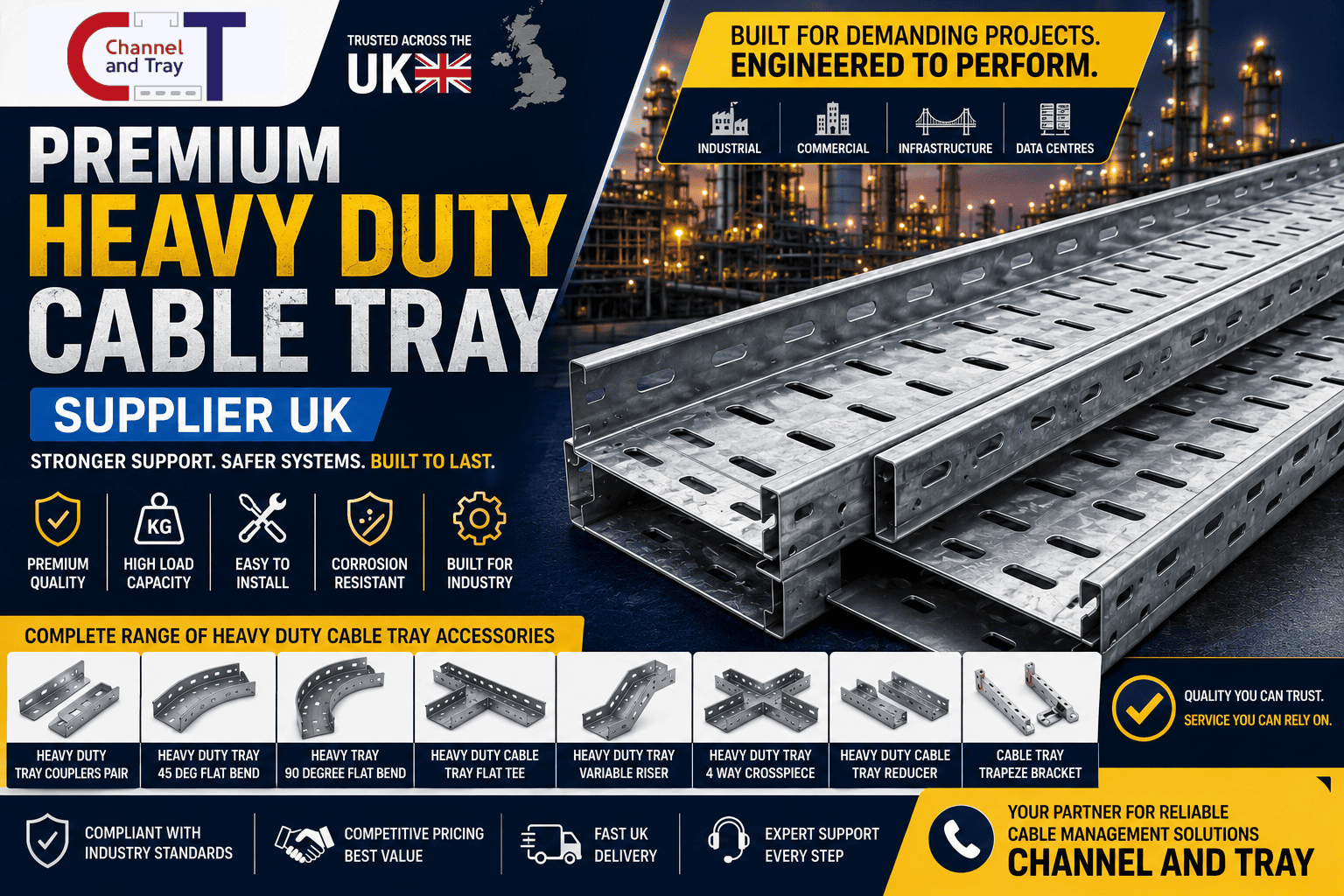
Heavy duty tray is built from thicker steel with a heavier structural profile. It carries significantly greater loads, spans longer distances between supports. They performs reliably in the most demanding industrial environments — power stations, manufacturing plants, chemical processing facilities, offshore installations, and large infrastructure projects.
Underspecifying here has serious consequences. Medium duty tray overloaded by heavy cable runs deflects, deforms, and can fail structurally. That is not a maintenance issue. It is a safety issue.
If the cable schedule shows large power cables in significant volumes. It specify heavy duty from the start.
Heavy Duty Tray Couplers Pair
The Heavy Duty Tray Couplers Pair joins heavy duty tray sections with the structural integrity the system demands.
These are not standard light duty couplers. The material thickness, fixing geometry, and load rating are all designed for heavy duty applications. Use the matched coupler for the tray you are installing. Nothing else.
Heavy Tray 90 Degree Flat Bend
The Heavy Tray 90 Degree Flat Bend handles right-angle horizontal direction changes in the heavy duty system.
Every change of direction in a heavy duty installation requires a purpose-built fitting. The structural loads at a 90-degree bend are significant — improvised direction changes create stress concentrations that will fail under the weight of a fully loaded heavy duty tray.
This fitting handles the geometry correctly and carries the load through the bend.
Heavy Duty Cable Tray Flat Tee
The Heavy Duty Cable Tray Flat Tee creates a T-junction in the heavy duty system — one main run continuing ahead, one branch leaving at 90 degrees.
In power stations, substations, and large industrial facilities, heavy duty cable routes frequently branch to serve multiple areas. Every one of those branches needs a properly engineered junction. This fitting provides it.
Heavy Duty Cable Tray Reducer
Cable volumes drop across a large industrial installation as circuits branch off. The Heavy Duty Cable Tray Reducer transitions between wider and narrower heavy duty tray sections cleanly and structurally.
Right-sizing the tray width throughout the run reduces material cost, reduces structural load on the support system, and gives the installation a logical, well-engineered appearance.
Metal Trunking — The Professional’s Choice for Enclosed Cable Management
Walk into any well-finished UK office, school, hospital, or retail unit and look at the cable management on the walls.
Chances are it is Metal Trunking.
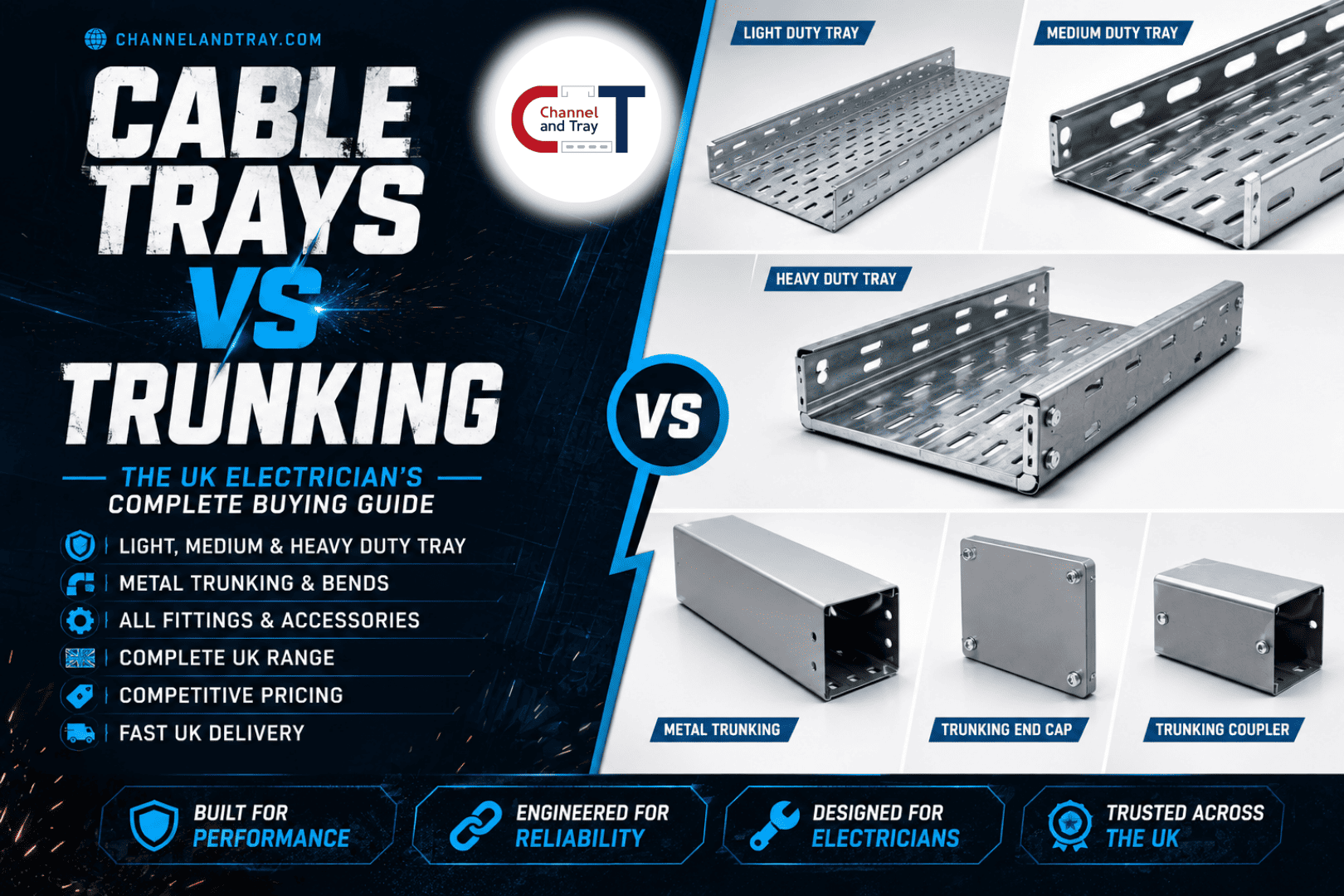
Metal trunking fully encloses cables behind a removable lid. It protects cables from physical damage and looks neat and professional. It suits environments where exposed cables are either a safety risk, an aesthetic problem or both.
Where metal trunking is the correct specification:
- Open-plan offices and commercial interiors
- School and college buildings
- NHS and private healthcare facilities
- Retail environments
- Hotel corridors and service areas
- Any installation where the public can see the cable management
The enclosed design also contributes to fire compartmentation in buildings. Cables pass through fire-rated walls or ceilings — a critical compliance consideration in many UK public buildings.
Metal Trunking & Bends
Metal Trunking & Bends cover all the directional changes a trunking run needs. Internal bends, external bends, and flat bends handle every combination of direction change — up a wall, around a corner, over a door frame.
Every direction change in a trunking run needs a proper bend fitting. Cutting and joining trunking at corners creates sharp edges, gaps in the enclosure, and a finish that does not meet the standard of the installation.
Trunking Inside Lid 45 Degree Bend
The Trunking Inside Lid 45 Degree Bend is the lid fitting that covers the trunking body at a 45-degree direction change.
The body and the lid are separate components in a trunking system. Every direction change needs both the correct body fitting and the correct lid fitting. The inside lid 45-degree bend is the lid component that completes the enclosure cleanly at a 45-degree turn.
Trunking Top Lid Tee
The Trunking Top Lid Tee is the lid fitting for T-junction points in the trunking run.
Where a trunking branch leaves the main run, the top lid tee covers the junction and maintains the enclosed, professional appearance of the system. Without it, the junction is open — exposing cables and creating a finish that no professional installer would accept.
Trunking Suspension Hanger
Overhead trunking runs need support. The Trunking Suspension Hanger suspends metal trunking from ceiling structures, soffits, and structural steelwork.
Correct support spacing prevents trunking from deflecting under cable load — which would deform the trunking profile, make lid removal difficult, and in extreme cases cause the trunking to detach from its fixings.
Always support trunking at the manufacturer’s recommended intervals using the correct suspension hanger.
Trunking Coupler
The Trunking Coupler joins trunking sections end to end.
It maintains the alignment and structural continuity of the trunking run and — critically — maintains the electrical continuity of the metal enclosure for earthing purposes. Never improvise a join between trunking sections. The coupler does the job correctly.
Trunking End Cap
The Trunking End Cap seals the open end of a trunking run.
Open trunking ends are a safety hazard — the raw metal edge can cut. They also look unfinished and allow dust and debris into the trunking cavity. The end cap eliminates all three problems in one simple fitting.
Always cap the ends. It costs next to nothing. It matters more than you might think.
Trunking Flange Plate
The Trunking Flange Plate connects the trunking system to walls, ceilings, or equipment enclosures at entry and exit points.
It creates a clean, sealed transition between the trunking and the surface or enclosure — essential for maintaining the integrity of the cable enclosure and achieving a professional finish at every termination point.
Trunking Reducer
Trunking sizes change as cable volumes reduce along a run. The Trunking Reducer transitions between a larger and smaller trunking section cleanly.
Without a reducer, the junction between two different trunking sizes creates a gap in the enclosure and an untidy finish. The reducer solves both problems and keeps the cable enclosure continuous throughout the run.
How to Choose Between Cable Tray and Trunking for Your UK Project
Here is the practical decision guide that pulls everything together.
Light Duty Cable Tray for:
- The installation is in a commercial office, retail unit, school, or healthcare building
- Cable volumes are moderate
- The tray runs in a ceiling void or plant room where aesthetics do not matter
- Budget efficiency is a priority without compromising quality
Medium Duty Cable Tray for:
- The installation involves a warehouse, manufacturing facility, hospital, or large commercial development
- Cable loads exceed what light duty tray handles comfortably
- The run spans areas where stronger structural support is needed
- You need the widest possible range of matched fittings and accessories
Heavy Duty Cable Tray for:
- The installation involves power stations, industrial plants, substations, data centres with high cable density, or offshore environments
- Large diameter power cables are in the schedule — 95mm² and above
- Long unsupported spans are required
- The environment is demanding — high temperatures, vibration, chemical exposure
Metal Trunking for:
- The cables will be visible to building occupants or the public
- A professional, finished aesthetic is required
- Physical cable protection is needed
- The installation is in an office, school, hospital, retail unit, or any public-facing environment
- Fire compartmentation requirements apply at cable penetration points
When the answer is not immediately obvious — think about who will see the installation, what cables it needs to carry, and what environment it will operate in. Those three questions point you to the right system almost every time.
Why Choose ChannelandTray for Cable Trays & Trunking in the UK?
Channelandtray is one of the most trusted and competitive suppliers of cable trays and trunking in the United Kingdom.
Here is what you get:
- Complete range across every duty rating — Light duty, medium duty, and heavy duty cable tray, plus the full metal trunking range, all available from one supplier. No splitting orders across multiple trade counters.
- Every fitting and accessory in stock — Flat bends, flat tees, couplers, reducers, stainless cable ties, bolt and nut sets, trunking hangers, end caps, flange plates — everything needed to complete a professional installation.
- Competitive UK pricing — channelandtray keeps prices sharp for UK trade buyers. Whether you are sourcing for a single domestic job or a major commercial project, the pricing works.
- Fast UK delivery — Stock ready for despatch. Orders processed and shipped quickly. Your project programme stays on track.
- Quality assured — Every product meets the relevant UK and European standards. Specified for professional installation use — not budget stock that causes problems on site.
- Easy online ordering — Find the product, check the specification, add to basket, order. Simple. Fast. Reliable.
Browse the full cable trays and trunking range at channelandtray
The choice between cable tray and trunking is straightforward once you know the rules.
Open tray for high-volume, industrial, and concealed runs. Enclosed trunking for visible, commercial, and aesthetics-sensitive installations. Light duty for standard commercial jobs. Medium duty for the majority of UK industrial and heavy commercial work. Heavy duty used for large, the loads are serious, and the environment is demanding.
Get the duty rating right. Use the correct fitting at every bend, junction, and direction change. Secure cables properly. Support the system at the right intervals.
That is what a professional installation looks like. And channel and tray stocks everything you need to build one — across the full range of cable trays and trunking, with every fitting and accessory in one place.
Browse the complete range at channel and tray — and get the right system for your next UK project.
FAQs
- What is the difference between cable tray and cable trunking?
Cable tray is an open support system — cables sit on or in the tray and are accessible from above. Metal trunking fully encloses cables behind a removable lid. Tray suits high-volume, industrial, and concealed installations. Trunking suits visible, commercial, and aesthetics-sensitive environments.
- Which duty rating of cable tray do I need?
Light duty for commercial installations with moderate cable loads. Medium duty for the majority of industrial and heavy commercial applications. Heavy duty for power stations, large industrial plants, and installations carrying large diameter power cables at significant loads. Always check load tables against your specific cable schedule and span before specifying.
- Can cable trays and trunking be used outdoors in the UK?
Yes — with the correct finish. Galvanised cable tray and trunking offer good outdoor corrosion resistance. For coastal, offshore, or chemically aggressive environments, specify hot-dip galvanised or stainless steel options. Always verify the product finish against the environmental exposure conditions.
- Does cable tray need to be earthed?
Yes. Metal cable tray forms part of the electrical installation and needs proper bonding and earthing in line with BS 7671. In many installations the tray system forms part of the circuit protective conductor arrangement. Always verify earthing continuity with proper testing — never assume.
- What fixings do I need for cable tray installation?
A complete cable tray installation needs: couplers to join sections, flat bends and tees at direction changes and junctions, reducers where tray width changes, stainless cable ties to secure cables, and bolts with hex flange nuts to fix components together. channelandtray stocks the complete accessories range for all duty ratings.
- What is a trunking coupler used for?
A Trunking Coupler joins two trunking sections end to end — maintaining alignment, structural continuity, and electrical continuity of the metal enclosure for earthing. Always use the correct coupler rather than improvising a join.
- Where can I buy cable trays and trunking in the UK?
channelandtray stocks the complete range of light, medium, and heavy duty cable trays, metal trunking, and all associated fittings and accessories — with competitive UK pricing and fast delivery.