Underspecify your strut channel on a UK industrial project and you will pay for it — in rework costs, failed inspections, and structural failures in live installations.
Strut channel is the structural backbone of every serious M&E and construction installation in the United Kingdom. Cable tray support. Pipe hangers. HVAC frameworks. Electrical panel mounting. Every one of these applications depends on strut channel that is correctly specified for the load, the environment, and the span.
Most specification errors come down to three things. Wrong gauge, finish, supplier. Get all three right and your installation performs for the life of the building. Get any one of them wrong and the consequences show up at the worst possible moment.
Channelandtray manufactures and supplies the complete range of strut channel for UK industrial projects — light gauge, heavy gauge, hot dipped galvanized, cut to length, and every accessory needed to complete a professional installation. This guide covers every product, every application, and every common question. Read it before you finalise your next specification.
What Is Strut Channel & Why Does Every UK Industrial Project Need It?
Strut channel is the first choice of UK M&E engineers. There is a reason for that.
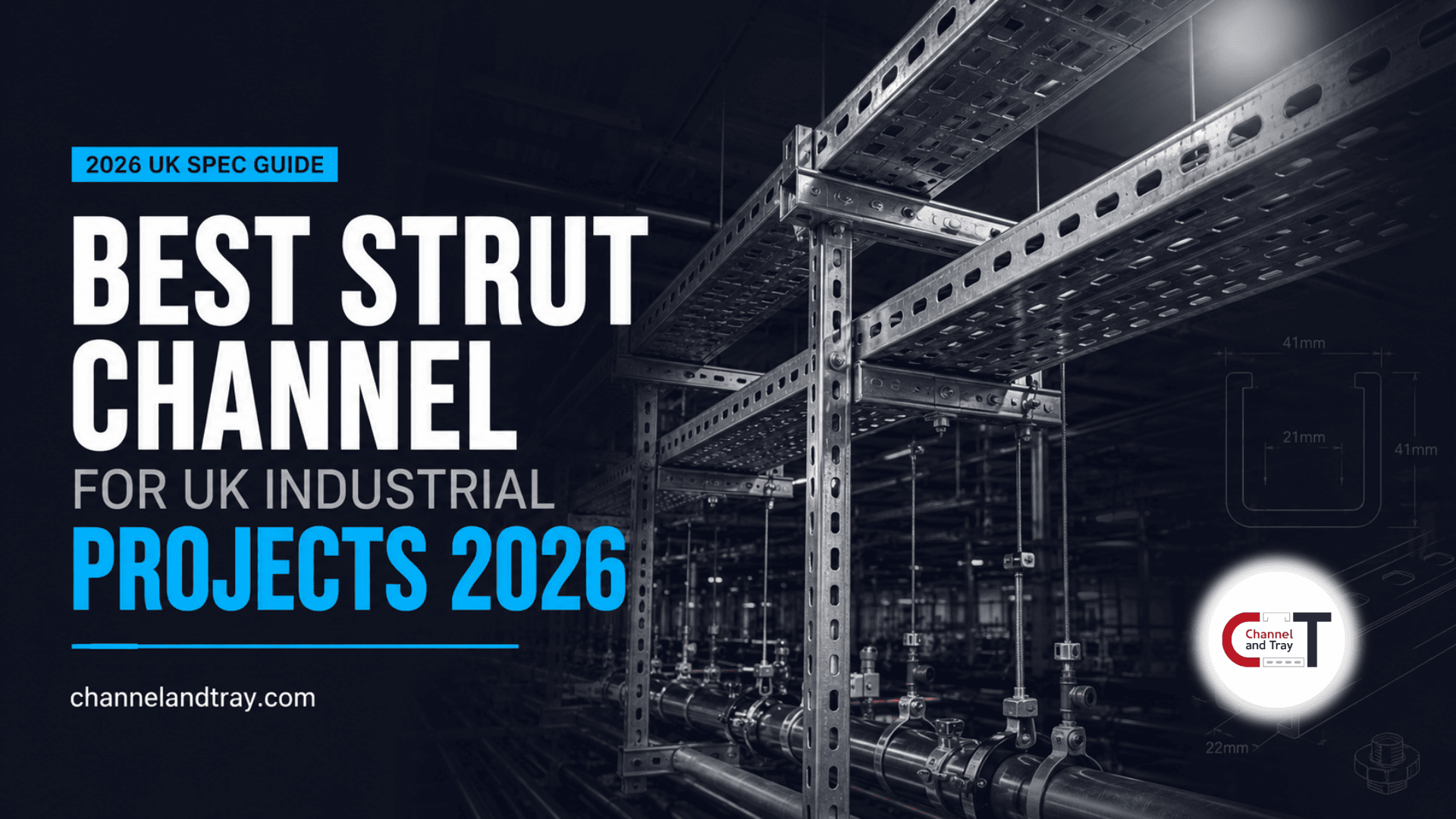
It is a standardised slotted metal channel — typically 41mm x 41mm profile — used to create support frameworks for mechanical and electrical systems. The continuous slot running along the face allows nuts, bolts, and fittings to be positioned anywhere along its length. No drilling. No fixed fixing points. Infinite adjustment during installation and after.
That flexibility is what sets strut channel apart from every other structural support option. A beam clamp fixes at one point. A drilled bracket fixes at one point. Strut channel fixes anywhere — and can be repositioned without creating new holes or weakening the structure.
What does strut channel support in UK industrial projects?
Every serious UK installation uses strut channel for:
- Cable tray and cable ladder support systems
- Pipework and pipe hanger systems
- HVAC ductwork and air handling unit supports
- Electrical distribution boards and panel mounting
- Solar panel mounting frames on UK commercial and industrial rooftops
- Structural frameworks in plant rooms, substations, and data centres
- General mechanical support frameworks across all UK industrial sectors
Why do UK M&E engineers default to strut channel?
Speed of installation. Flexibility of adjustment. Compliance with UK structural and electrical standards. And the ability to use one standardised system across every application on a project — rather than specifying bespoke brackets for every individual fixing requirement.
In the United Kingdom, strut channel installations must comply with relevant sections of BS 7671 (IET Wiring Regulations) for electrical support systems, and with applicable structural loading standards for mechanical applications. Channelandtray supplies strut channel that meets all relevant UK and European standards.
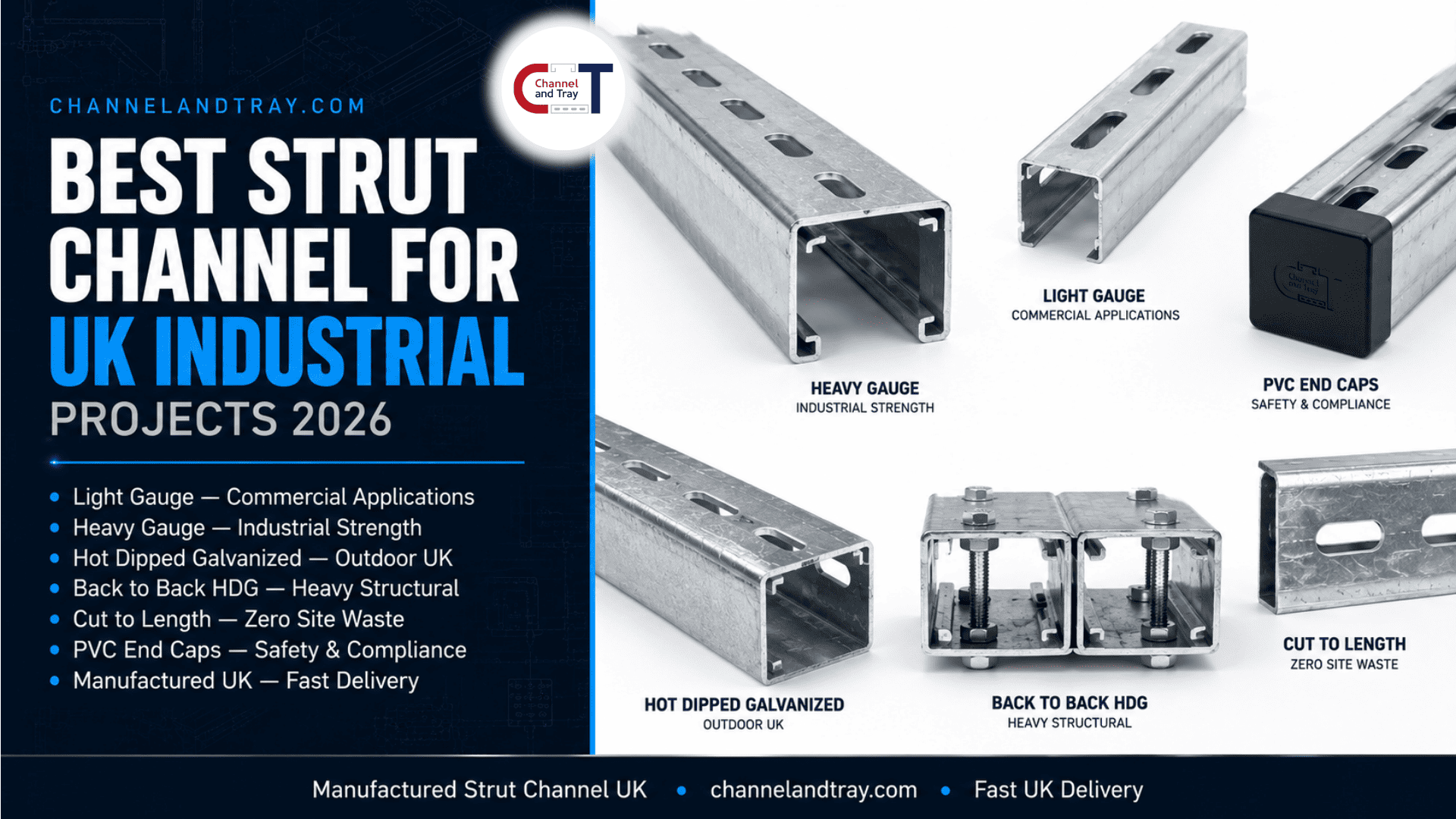
1. Light Gauge Strut Channel
Light Gauge Strut Channel has a clearly defined role. Step outside that role and it fails.
The thinner steel section of light gauge channel gives it a lower load capacity and a shorter maximum span compared to heavy gauge. That is not a weakness — it is a design characteristic that makes it the correct, cost-effective choice for the right applications.
Where Does Light Gauge Strut Channel Belong?
Light gauge is the correct specification for:
- Commercial office buildings where cable loads are moderate and spans are standard
- Retail fit-outs and shop installations
- Schools, colleges, and educational facilities
- NHS and private healthcare buildings with standard M&E loads
- Light cable management support in low-load environments
- Data and communications cabling support in commercial buildings
In a typical 10,000 sq ft UK commercial office fit-out, light gauge strut channel handles the entire cable management support framework — from ceiling void to plant room — at the correct specification and the most cost-effective price point.
What Goes Wrong When a Light Gauge Is Misspecified?
The most common and costly mistake on UK industrial projects: light gauge strut channel specified where heavy gauge is required.
In a UK manufacturing facility, a project manager specified light gauge channel to save cost on a cable tray support framework. Within 18 months the channel had deflected visibly under the cable load. The tray was out of alignment. The cable routes had shifted. A full replacement was required at three times the original cost.
Light gauge channel does not deflect gradually and warn you. It deflects to a threshold — and then the failure accelerates. Specify it correctly from the start.
Always cross-reference your cable load and span requirements against the manufacturer’s load tables before specifying light gauge on any UK industrial project.
2. Heavy Gauge Strut Channel
When the load is serious, the span is long, and the environment is demanding — Heavy Gauge Strut Channel is the only correct specification.
Strut Channel Heavy Gauge is manufactured from thicker steel — delivering significantly greater load capacity, longer maximum spans, and greater resistance to deflection under sustained load. That material difference is not marginal. In demanding UK industrial applications, it is the difference between a structure that performs and one that fails.
Where Is Heavy Gauge Strut Channel Essential?
Specify heavy gauge for:
- Power stations and electrical substations across the UK
- Manufacturing and automotive plants
- Hyperscale and edge data centres — the UK is now Europe’s largest data centre market
- NHS acute hospitals and major healthcare infrastructure
- Offshore installations and coastal industrial facilities
- Large warehouses and distribution centres
- Any application where cable tray, pipework, or mechanical loads are substantial
- Long-span frameworks where the channel must bridge significant distances between fixings
In a large UK data centre project in Slough, the M&E engineer specified heavy gauge strut channel throughout the cable management support framework. The framework carries hundreds of metres of cable tray loaded with large power cables. Two years into operation it has not deflected a millimetre. That is what the correct specification delivers.
What Is the Real Difference Between Light and Heavy Gauge?
Material thickness. Load tables. Maximum span. That is it.
Light gauge is typically 1.5mm–2.0mm steel. Heavy gauge is typically 2.5mm–3.0mm steel. The difference in weight per metre is modest. The difference in load capacity is substantial — heavy gauge can carry significantly more load across significantly longer spans.
For a UK power station installation carrying cable tray loaded with 240mm² power cables, the choice between light and heavy gauge is not a cost decision. It is a structural engineering decision. Heavy gauge is not a premium specification — it is the correct specification.
3. Strut Channel Hot Dipped Galvanized
Standard zinc plating protects the strut channel in dry internal environments. The moment you move outside — or into a demanding internal environment — it starts to fail.
Strut Channel Hot Dipped Galvanized changes that entirely.
What Is Hot Dip Galvanising & Why Does It Matter?
Hot dip galvanising is not a coating. It is a metallurgical process.
The steel channel is immersed in molten zinc at approximately 450°C. The zinc bonds chemically with the steel surface — creating a series of zinc-iron alloy layers that become part of the steel itself. The result is a zinc layer that is four to six times thicker than standard electroplated zinc plating — and fundamentally more durable.
Standard zinc plating sits on top of the steel. HDG becomes the steel surface. That distinction is critical in outdoor, coastal, and chemically aggressive environments across the UK.
Where Is Strut Channel Hot Dipped Galvanized Specified in the UK?
Specify Galvanised Strut Channel in the hot-dip format for:
- Outdoor cable management support structures — rooftops, external plant areas, exposed walkways
- Coastal and offshore industrial installations anywhere around the UK coastline
- Water treatment and sewage treatment facilities
- Chemical and pharmaceutical processing plants
- Car parks — both open and multi-storey — where moisture and de-icing salt are constant
- Tunnels and underground infrastructure
- Agricultural and food processing buildings with high humidity
- Any installation where the channel will face prolonged moisture, chemical exposure, or the UK weather
A UK water treatment plant in Yorkshire specified standard pre-galvanised strut channel on an external pipe support framework. Within four years the channel was showing significant corrosion. The entire framework required replacement with Strut Channel Hot Dipped Galvanized. The replacement cost was eight times the original saving on finish specification.
What Is Strut Channel Hot Dipped Galv (Back to Back)?
Back to back strut channel is two channel sections fixed back to back — creating a heavier, deeper structural section with significantly greater load capacity than a single channel.
Strut Channel Hot Dipped Galv (Back to Back) brings the corrosion resistance of hot-dip galvanising to this double-channel structural format. It is specified for:
- Heavy structural frameworks in outdoor environments
- Large-scale cable management support in exposed industrial areas
- Applications where single channel does not provide adequate load capacity in a corrosive environment
- Overhead support frameworks in outdoor UK industrial facilities
Back to back HDG channel is the specification when both structural demand and environmental exposure are at their most challenging.
4. Strut Channel Cut to Length
Time is money on a UK construction site. Strut Channel Cut to Length gives you both back.
What Does Cut to Length Mean in Practice?
Cut to length means your strut channel arrives on site pre-cut to your specified dimensions — ready to install, with no measuring, no cutting, no waste, and no offcuts to manage or dispose of.
For a UK contractor pricing a 500-rack data centre installation in London, the difference between ordering standard lengths and ordering cut to length is significant. Standard lengths mean site cutting operations, cutting equipment, safety considerations, and significant offcut waste. Cut to length means components are unboxed and installed — nothing else.
Why UK Contractors and Procurement Teams Specify Cut to Length
The practical benefits are straightforward:
- No site cutting operations — faster installation, lower labour cost
- Zero material waste — you pay for exactly what you use
- Consistency — every component cut to the same precise dimension
- Cleaner, safer sites — no offcuts, no cutting equipment, no cutting PPE
- Programme certainty — components arrive installation-ready
- Procurement efficiency — one order, one delivery, everything correct
On a large UK manufacturing plant installation in Birmingham, the M&E contractor switched from standard lengths to cut to length on the strut channel order. Site installation time reduced by 22%. Waste disposal costs dropped to zero. The programme delivered two days early.
Can Strut Channel Be Cut on Site in the UK?
Yes. Strut channel can be cut on site using an angle grinder with a metal cutting disc or a metal-cutting hacksaw. Always wear appropriate PPE — eye protection, gloves, and hearing protection.
One critical point: cut ends on Strut Channel Hot Dipped Galvanized expose raw steel at the cut face. Always treat cut ends with a zinc-rich cold galvanising compound to restore corrosion protection. Fit a PVC End Cap for Strut to all cut ends immediately after cutting.
5. PVC End Cap for Strut
Open strut channel ends are a health and safety liability. Sharp metal edges cut. They also look unfinished and allow moisture and debris into the channel cavity.
PVC End Cap for Strut solves all three problems with one low-cost fitting.
Why Does Every Professional UK Installation Include End Caps?
The PVC End Cap for Strut fits over the open end of any cut strut channel section. It eliminates the sharp metal edge entirely — removing the primary hand injury risk at every channel end on the installation.
Beyond safety, end caps deliver:
- A clean, professional finish at every channel termination point
- Prevention of dust, debris, and moisture ingress into the channel cavity — critical in outdoor and industrial environments
- Compliance with UK health and safety requirements for sharp edges on installed equipment
- A visual signal of professional workmanship — commissioning engineers and quality auditors notice end caps
The cost of a PVC end cap is negligible. The cost of a hand laceration on a live UK construction site — in terms of HSE investigation, programme disruption, and human impact — is not.
Always include PVC End Caps for Strut in every strut channel order. Every cut end. Every time.
In exposed outdoor installations, end caps also prevent water pooling inside the channel cavity — which accelerates internal corrosion even on galvanised channel. One small fitting. Significant long-term protection.
Channelandtray — Manufactured Strut Channel UK
One supplier. Complete range. Competitive pricing. Fast delivery.
Channelandtray manufactures and supplies strut channel directly to UK contractors, engineers, and procurement teams — cutting out the middleman and keeping prices sharp.
Why UK Professionals Choose Channel and Tray
- Manufactured Strut Channel UK — Channelandtray supplies directly manufactured strut channel, not resold stock. That means quality control from production to delivery and pricing that reflects direct supply.
- Strut Channel Supplier UK — the complete range is available from one source. Light gauge for commercial applications. Heavy gauge for industrial. Hot dipped galvanized for outdoor and aggressive environments. Back to back for heavy structural applications. Cut to length for installation efficiency.
- Galvanised Strut Channel — both pre-galvanised and hot-dip galvanised options are stocked and available for immediate despatch. No waiting on special orders for the finish you need.
- Unistrut Channel UK — Channelandtray supplies strut channel compatible with standard unistrut fittings and accessories. The full range of nuts, bolts, brackets, beam clamps, and channel accessories is available alongside the channel itself.
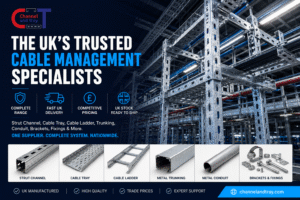
- Cable Tray Supplier UK — strut channel does not exist in isolation. It supports cable tray, cable ladder, and complete cable management systems. Channelandtray supplies the complete package — strut channel, cable tray, cable ladder, metal trunking, metal conduit, and every associated fitting and accessory.
- Cable Ladder Supplier UK — cable ladder for industrial applications is stocked alongside the strut channel support systems that carry it.
- Cable Management Systems UK — specify the entire cable management system from one supplier. No split orders. No coordination between multiple suppliers. One order, one delivery, one invoice.
- Cable Tray Manufacturer UK — UK-based supply with fast despatch means your programme stays on track.
Every product meets relevant UK and European standards. Ordering online takes minutes. Delivery is fast. Pricing is competitive for both individual trade orders and large-scale procurement.
Browse the complete strut channel range at Channelandtray website.
When your specification is finalised and your order is ready, Channelandtray is the call that keeps your project on programme and on budget.
Right Channel. Gauge. Finish. Supplier.
- Right channel. Strut channel is the structural backbone of every serious UK M&E and industrial installation. Specify it correctly and the framework performs for the life of the project. Specify it wrong and the consequences are structural, financial, and reputational.
- Right gauge. Light gauge for commercial and lower-load applications. Heavy gauge for industrial, long-span, and high-load applications. The distinction is not a cost decision. It is an engineering decision. Never substitute.
- Right finish. Pre-galvanised for dry internal environments. Hot dipped galvanized for outdoor, coastal, humid, and chemically aggressive environments anywhere in the United Kingdom. The additional investment in HDG finish pays back many times over in service life and avoided replacement costs.
- Right supplier. Channelandtray manufactures and supplies the complete strut channel range for UK industrial projects — every gauge, every finish, cut to length, with every accessory in stock, at competitive UK pricing, with fast delivery.
Get all four right. Every project. Every time. That is the standard of a professional UK installation — and Channelandtray is the supplier that makes it straightforward.
Strut Channel FAQs —
What is strut channel used for in UK industrial projects?
Strut channel is a slotted steel channel used to create structural support frameworks for cable trays, pipework, HVAC systems, electrical panels, and general mechanical and electrical installations. Its continuous slot allows infinite fixing point adjustment without drilling. UK M&E engineers use it on virtually every serious industrial and commercial project.
What is the difference between light and heavy gauge strut channel?
The difference is material thickness and load capacity. Light gauge is typically 1.5mm–2.0mm steel, suited to commercial and lighter-duty applications. Heavy gauge is typically 2.5mm–3.0mm steel, designed for industrial applications, longer spans, and heavier loads. Never substitute light gauge where heavy gauge is the correct specification.
What does hot dipped galvanized strut channel mean?
Hot dip galvanising is a process where the steel channel is immersed in molten zinc, creating a metallurgical bond that is fundamentally more durable than standard electroplated zinc plating. Strut Channel Hot Dipped Galvanized is the correct specification for outdoor, coastal, humid, and chemically aggressive environments across the UK.
Can strut channel be cut to length in the UK?
Yes. Strut Channel Cut to Length is available from Channelandtray — pre-cut to your specified dimensions, ready to install on site. Channel can also be cut on site using an angle grinder or hacksaw. Always treat HDG cut ends with cold galvanising compound and fit PVC end caps.
What is back to back strut channel used for?
Back to back strut channel is two channel sections fixed together — creating a deeper, stronger structural section with significantly greater load capacity than a single channel. Strut Channel Hot Dipped Galv (Back to Back) is specified for heavy structural frameworks in outdoor and corrosive UK environments.
What is a PVC end cap for strut channel?
A PVC End Cap for Strut is a plastic cap that fits over the open end of a cut strut channel section. It eliminates sharp edges, prevents dust and moisture ingress, and gives a professional finish. It is a health and safety requirement in UK installations where personnel may contact open channel ends.
Where can I buy manufactured strut channel in the UK?
Channelandtray supplies manufactured strut channel directly across the United Kingdom — light gauge, heavy gauge, hot dipped galvanized, cut to length, and all accessories. Competitive pricing, fast despatch, and quality assured products are available online at Channelandtray.
Is strut channel the same as unistrut channel?
Strut channel and unistrut channel refer to the same standardised product — a slotted steel support channel in a standard 41mm x 41mm profile. Unistrut is a brand name that has become a generic term in the UK industry. Channelandtray supplies strut channel fully compatible with standard unistrut fittings and accessories.